
Colive Goto Island Coliving Review (2026): The Most Immersive Japan Local Experience in a UNESCO-Adjacent Island Coliving — Fukue Island, Nagasaki
Honest Colive Goto Island coliving review (2026). Six private rooms on the 2nd floor of Serendip Hotel Goto in Fukue Port town, Nagasaki — operated by yugyo inc., the team behind Colive Fukuoka. High-speed Wi-Fi, private coworking, fully equipped kitchen, and the most immersive local Japanese island experience available to a digital nomad anywhere in the country. The hidden Christians' archipelago, Japan's top 100 beaches, dawn fishing at the port, Goto udon, evening yatai. From $620/month all-inclusive. This is what it's actually like.
What Is Colive Goto Island?
There is a coliving that happens to be located in Japan, and then there is Colive Goto Island — a coliving designed, from the ground up, so that you actually live in Japan.
The distinction is not as common as it sounds. Most coliving spaces in Japan, as elsewhere, sit inside cities — useful, comfortable, well-connected, but fundamentally visitor infrastructure. The country passes by the window. Colive Goto is different in exactly the way that the team who built it, yugyo inc., describes their entire philosophy: chiiki ni nezasu tsuchi to nare — "become the soil from which the local community grows." It is a coliving built to place you inside a living island community, not adjacent to it.
Colive Goto opened in July 2023, making it one of the earliest purpose-built international-facing rural colivings in Japan. It occupies the entire second floor of Serendip Hotel Goto — a ten-minute walk from Fukue Port, the central hub of Fukue Island — and accommodates a maximum of six people in private rooms. The space includes dedicated coworking, a fully equipped kitchen, high-speed Wi-Fi, and the practical full-furnishing of a space where you land and start living, not decorating.
The address is 武家屋敷1-7-12 (Buke Yashiki 1-7-12), Goto City, Nagasaki Prefecture 853-0017 — on Fukue Island, the largest of the Goto Islands, an archipelago of approximately 140 islands scattered roughly 100 kilometres west of Kyushu into the East China Sea. The islands are classified as part of the UNESCO World Heritage property "Hidden Christian Sites in the Nagasaki Region" (inscribed 2018). Takahama Beach on Fukue Island is on Japan's official list of Top 100 beaches. Goto udon is one of Japan's three great udon traditions. The cobalt water has been described, repeatedly and by people who have seen a lot of ocean, as Okinawa-quality without Okinawa's crowds.
The operator, yugyo inc., is the same organisation behind Colive Fukuoka — the annual nomad gathering that won the Nomad Retreats Award for Best Global Nomad Fest 2025 by popular vote from nearly 700 nomads worldwide, and that generated ¥140 million in local economic impact in its 2025 edition alone. Colive Goto is their small-scale, permanent residential expression of the same philosophy: that the most valuable thing they can give an international remote worker is not a co-working desk in a city, but a genuine doorway into the texture of life in Japan that tourism cannot reach.
Ryo Osera, yugyo's founder — a Nagasaki native, a co-founder of HafH (Japan's subscription-based coliving platform), and the executive advisor to the Japan Workcation Association — built Colive Goto on his home prefecture's coastline. The intent is personal, and the place reflects it.
This review tells you what that means in practice.
Colive Goto Island Is Best For
✓ Digital nomads who want an authentic, unhurried Japanese island life experience — not a tourist visit, a residency ✓ Remote workers holding Japan's Digital Nomad Visa (introduced 2024) who want a base outside Tokyo and Osaka ✓ Anyone coming to or from Colive Fukuoka in October who wants to extend their Japan experience into the real countryside ✓ Writers, photographers, artists, and deep-focus workers who need extraordinary environment without urban noise ✓ Japan enthusiasts — travellers serious about the culture who want to leave the standard circuit of Tokyo-Kyoto-Osaka behind ✓ Solo travellers who want an intimate, maximum-six-person community with immediate local integration ✓ Those curious about Japan's Hidden Christian history, island gastronomy, natural wilderness and coastal culture at the source
Book Colive Goto Island → 🌐 yugyo.work/coliving 📞 Contact via Tally form: tally.so/r/wz7bOM 📧 yugyo inc.: tally.so/r/n07key 📍 武家屋敷1-7-12, Goto City, Nagasaki 853-0017, Japan 📸 Instagram: @colivegoto
Why Colive Goto Is Different
Most colivings in Japan are, in practice, urban. This is logical: Japan's cities are magnificent, well-served by infrastructure, and have developed coworking ecosystems. But they share a problem — the Japan that most remote workers are looking for, the Japan they have read about and imagined, is not primarily a city experience. It is the fishing village at six in the morning where the boats are coming in. It is the weather-worn church on a clifftop that a community built in secret after three hundred years of persecution. It is the izakaya where the master has been serving the same dishes for forty years to the same fishermen, and where you are not a tourist but a neighbour.
Colive Goto was designed to deliver that Japan, and not accidentally.
The facility is embedded inside Serendip Hotel Goto, a property the name of which derives from SERENDIPITY — the hotel's founders built the space explicitly around the idea that long stays produce unexpected and meaningful encounters. The ground floor café is not a coliving amenity. It is a local café that the whole town uses, where residents drink coffee alongside remote workers, where the counter serves as an informal community switchboard for anyone who stays long enough to become a regular. The coliving is on the second floor. The port is a ten-minute walk. The supermarket is close. The evening tavern (居酒屋 / izakaya) is on the same second floor as the coliving rooms — a detail that is not incidental. It means that an ordinary Tuesday night can end with a bowl of Goto udon and a glass of locally produced shochu next to the fishermen who caught the fish you ate for lunch.
Yugyo's model across all its programmes is what Ryo Osera calls "Sight-Connecting" — not sightseeing, but genuine connection between nomads and local communities, structured so that both parties benefit. At Colive Goto, this is operational rather than aspirational. The small capacity (six people maximum) is a deliberate choice that makes it impossible to exist as a coliving bubble inside the island. There are not enough of you to form a self-contained community. You have to reach outward, and the island is waiting.
One participant from Colive Fukuoka, Pablo Riveros, wrote about arriving at the Serendip Hotel having taken the overnight ferry from Fukuoka with a group of nomads: "Our accommodation with CoLive Goto was equally fantastic, providing a cozy spot to relax, connect with new faces, and just soak in the island's charm." He singled out the personalised tour arranged by Ryo Osera and the warmth of every local host encountered. That guest experience — deeply personalised, deeply local, impossible to replicate through a booking platform — is the core product.
The Location: Fukue Island, the Goto Archipelago, and What "Remote" Actually Means
The Goto Islands sit in the East China Sea, roughly 100 kilometres west of Nagasaki city, closer to Korea and China than to Tokyo. Fukue Island (福江島) is the largest, with a population of approximately 38,000, and hosts the archipelago's only airport (Goto Tsubaki Airport / 五島つばき空港) and the main port (Fukue Port). The island's central town — also called Fukue — is where the coliving is based: a working harbour town with the ruins of Ishida Castle, a samurai-era residential quarter (武家屋敷), a covered market, a supermarket, local restaurants, the port ferry terminal, and the Serendip Hotel at its edge.
The Goto Islands were among the last refuges of Japan's Hidden Christians — the kakure kirishitan — who practised their faith in secret for nearly three centuries after the Tokugawa shogunate banned Christianity in the early 1600s. Forced to disguise Catholic devotion within Buddhist and Shinto forms, their communities survived on the islands' remoteness until the ban was lifted in 1873. The churches they then built — brick Gothic, Romanesque, simple island stone — are scattered across Fukue and the surrounding islands. Four of these sites were inscribed in the UNESCO World Heritage list in 2018 as part of the "Hidden Christian Sites in the Nagasaki Region." Dozaki Church (the first Christian church built on Fukue after the ban's lifting, 1908) is a 30-minute drive from the coliving. Egami Church on Naru Island — described by multiple independent travellers as one of the most beautiful wooden churches in Japan — is accessible by ferry.
Outside the churches, the island is volcanic in origin and wild in character. Mount Onidake (315m, dormant for approximately 20,000 years) is a 30-minute hike from the road to its summit. The Osezaki cliff walk on Fukue's northern cape, the lava-formed coastline near the Abunze Visitor Center, the grassy hilltop cemetery at Fuchi-no-moto where Hidden Christians are buried facing a wild western shore — these are not listed attractions. They are what you find when you have a bicycle and a month.
Takahama Beach on the western coast of Fukue is on the official Japan Top 100 Beaches list — a perfectly curved cove where the water transitions from turquoise to deep sapphire as it deepens, and where in early October you may share it with one other person. The beaches of the east coast, gentler and more accessible, support sea kayaking, stand-up paddleboarding, and snorkelling. Kojima Beach is a local favourite with cerulean waters.
The food culture of Goto is specific and significant. Goto udon is one of Japan's three great udon traditions — thinner than most, dried on the sea wind, with a uniquely elastic texture that comes from being coated in camellia oil (tsubaki oil, Goto's other famous product). Kibinago (a small silver fish), Goto wagyu (raised on the island's grasslands), Goto pork, island gin, island wine, and local shochu are the culinary materials available within walking distance of the coliving. The izakaya Kimagure on the same second floor of the hotel is the most direct entry point into this food culture on an ordinary evening.
Destination | Journey |
Fukue Port (ferries, town centre) | 10 min walk from coliving |
Serendip Hotel café (ground floor) | Same building, steps |
Izakaya Kimagure (evening pub) | Same building, 2nd floor |
Supermarket | Short walk from hotel |
Goto Tsubaki Airport (FUJ) | 7 min by car |
Dozaki Church (first post-ban church) | 30 min drive |
Takahama Beach (Japan Top 100) | ~45 min drive |
Mount Onidake summit | ~30 min hike from road |
Naru Island / Egami Church | ~30 min ferry |
Nagasaki city | ~90 min by jetfoil or ~3.5h by ferry |
Fukuoka | ~40 min by flight, or overnight ferry |
Getting to Fukue Island: Fly from Fukuoka Airport (approximately 40 minutes, multiple daily flights, fares approximately ¥8,000–¥19,000 one way). Alternatively, take the jetfoil from Nagasaki Port (approximately 90 minutes, ~¥9,000) or the overnight ferry from Fukuoka (approximately 8 hours — romanticised by nomads who have done it as a genuine experience in itself, with sleeping areas and a small casino on board). Within Fukue Island, a rental car or electric bicycle significantly expands access. Serendip Hotel provides e-bike rental (Yamaha PAS Brace sport e-bikes and one child-carrier model) at ¥2,000/day or ¥500/hour.
There is no public transport to speak of beyond infrequent bus services. Getting around Fukue meaningfully requires a rental car or a bicycle. This is not a limitation unique to the coliving; it is the honest condition of island life in rural Japan. The taxi network exists and functions; Goto City also has an impressive fleet of electric rental cars (due to the island's environmental commitments), available from the port.
The Space: 6 Rooms, a Private Cowork, and a Hotel That Becomes a Community
Colive Goto occupies the second floor of Serendip Hotel Goto entirely — a set of six private rooms with a dedicated coworking space, fully equipped kitchen, and private bathroom facilities, fully furnished and ready from day one of arrival. The arrangement is operational and intentional: the second floor is the coliving; the ground floor is where the hotel's public café and community spaces operate.
The Rooms are six private rooms, each individually furnished. All rooms include high-speed Wi-Fi and full furnishing, including linen (towels are provided, so guests do not need to bring their own). The rooms are hotel-standard — not luxury, not basic — which is appropriate for a space designed for month-long residency rather than weekend stays. English language support is included in the rent.
The Coworking Space is a private dedicated space, exclusive to coliving residents. It is not shared with the hotel or the public. For a maximum of six residents, this means a genuinely quiet, fully accessible workspace at all times. The internet connection is high-speed; the coliving page emphasises reliable fast Wi-Fi as a core offering.
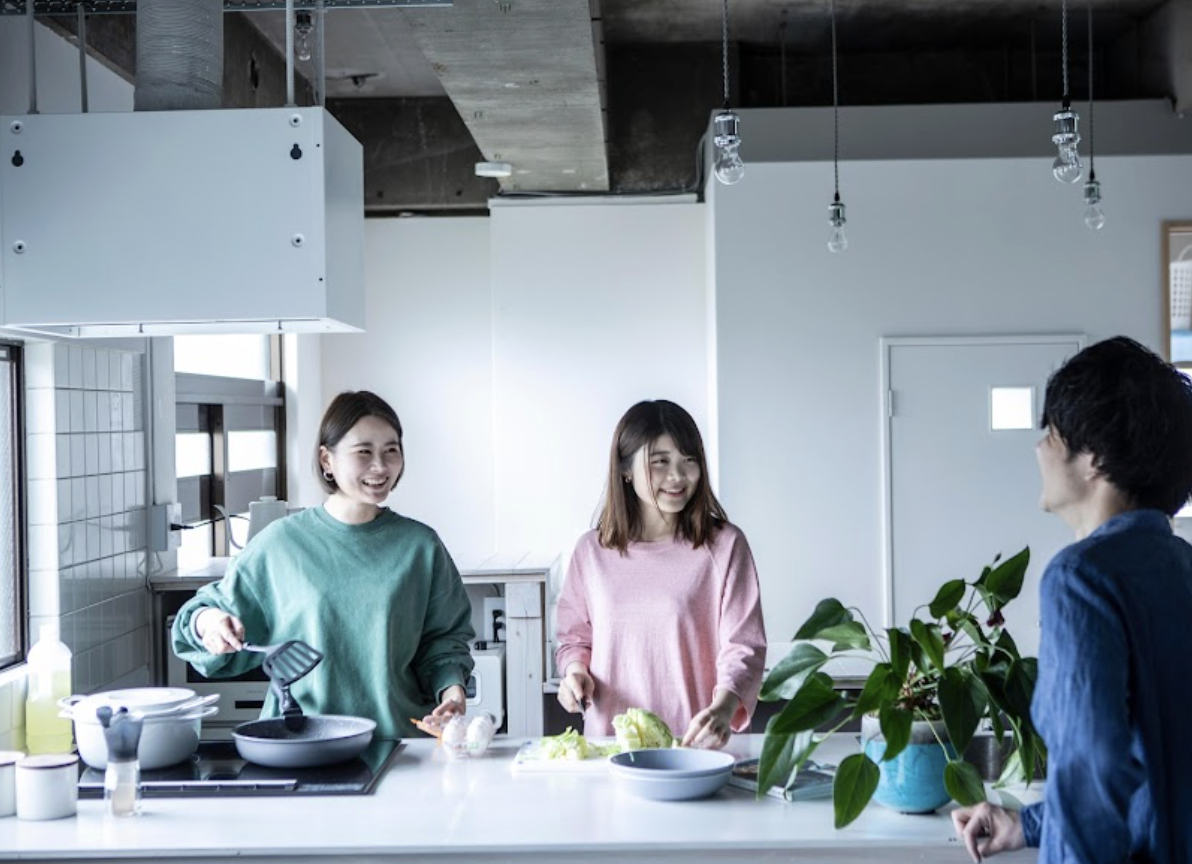
The Kitchen is fully equipped for daily living — not a symbolic kettle and a microwave, but a working kitchen with the appliances and storage needed to cook seriously for an extended stay. Given the quality and specificity of Goto's local produce — fresh fish, island vegetables, camellia oil, Goto pork — the kitchen is not an afterthought. It is how you access the island's food culture beyond restaurant meals.
The Café and Izakaya are on the ground floor and second floor respectively, and both function as community anchors. The ground floor café is the morning and daytime gathering point for the whole building — locals, hotel guests, coliving residents, passers-by — and is described as a place of unexpected encounters characteristic of long stays. The izakaya Kimagure on the second floor is the evening equivalent: island shochu, Goto udon, fresh seafood, and the kind of casual cross-table conversation that turns neighbours into friends.
The Hotel's Other Facilities include meeting rooms (2–3 person and 8-person, available by the 15-minute slot), coin laundry, a kids' space, a full suite of free-rental equipment (Logicool video conferencing cameras, extension cords, drying racks, document storage), and electric bike rental.
The Rooms: Private, Furnished, All-In, All Six of Them
All six rooms at Colive Goto are private. There are no dormitories. Rates as of the launch period:
Monthly Rate: From $620/month (all-inclusive). This rate covers rent, utilities, Wi-Fi, linen, and English-language support. Pricing listed as flexible from Spring 2024 onwards — confirm current rates directly, as yugyo regularly updates pricing and offers discounts for specific situations.
Deposit: $300 USD, refunded on departure assuming no issues.
Available discounts: Repeat visitors, long-term stays, couples, and referrals all have specific discount structures. Mid-month arrivals have daily rate options. Contact yugyo directly to discuss.
The all-inclusive nature of the rate is a meaningful practical feature. In Japan, housing costs frequently carry hidden additions — administrative fees, guarantor requirements, agency fees that can add 2–3 months of rent to the first payment. Colive Goto's flat rate, inclusive of utilities and Wi-Fi, removes this entirely. You pay, you arrive, you live.
The monthly rate of $620 requires context. Japan is not an inexpensive country, and island accommodation with full furnishing, high-speed internet, private coworking, and English support in one of the country's most historically and naturally extraordinary archipelagoes is not priced at Tokyo studio-apartment rates. The comparison that matters is: what does a month of genuine immersion in rural island Japan cost if you arrange it independently? The answer is substantially more, in both money and logistics, and without the community or English support.
The Community: Six People and an Entire Island
The community at Colive Goto is defined by its smallness at the coliving level and its openness at the island level. With six rooms and a maximum of six residents, there is no critical social mass within the building. What there is instead is something rarer and more meaningful: direct, daily integration with the life of the island.
Yugyo inc.'s philosophy — built from the ground up by Ryo Osera, a Nagasaki native who grew up believing that "life changes when you meet the right people" — is that the most valuable community experience for a digital nomad is not meeting other digital nomads. It is meeting the Japanese fisherman, the café owner, the church-keeper, the farmer who grows the vegetables at the market on Wednesday morning. Colive Goto is designed to make those encounters happen, not as organised excursions, but as the natural consequence of living in a place for a month.
The connection to the Colive Fukuoka community is a significant secondary layer. Yugyo's Fukuoka programme has built a network of over 1,000 members from 55+ countries, and Colive Goto is explicitly recommended within that community as the natural complement — the post-conference retreat, the "what Japan actually is" after the city introduction. Pablo Riveros, a nomad who made the overnight ferry from Fukuoka to Fukue with a group of Colive Fukuoka participants, wrote: "What could have been a long eight-hour ride turned into a joyful mini-cruise — it set the perfect tone for the incredible friendships that blossomed throughout our trip." The connection between the two Colive properties is deliberate and active.
For individual residents booking directly, the yugyo team provides English-language support, local introductions, and — in the manner of Ryo Osera's hands-on approach across all his programmes — personalised guidance on what to see, who to meet, and how to engage with the specific character of Goto that would take an independent visitor months to discover.
One Japanese travel guide (japanlivingguide.com) describes the Goto coliving this way: "The coliving space on the Goto Islands is a place where you can interact with locals and nature. During the day, you can remote work comfortably in the café and other spaces, and in the evening enjoy fishing at the nearby port or local flavors at the lively tavern on the second floor. It is an ideal share house where you can easily experience life in Goto." That sentence — unpoetic and unmarketed — captures something exactly right.
What People Say
Colive Goto is a small, young, and deliberately under-publicised coliving — a maximum-six-person space on a remote island is not a property with thousands of TripAdvisor reviews. What exists comes from three sources: the Colive Fukuoka community, independent travellers who have found their way to Goto, and the Japan National Tourism Organization, which featured Goto specifically as the ideal nomad destination for participants post-Colive Fukuoka.
On the arrival experience and the hotel: "Our first stop on the island was the delightful Serendip Hotel Goto Islands, a true haven for coffee lovers and breakfast enthusiasts. Seriously, the aroma alone was enough to make you smile! Our accommodation with CoLive Goto was equally fantastic, providing a cozy spot to relax, connect with new faces, and just soak in the island's charm." — Pablo Riveros, Colive Fukuoka nomad, Medium, June 2025
On the local food and the island: "Our taste buds were in for a serious treat at 'Itsukuyama,' a super charming rice shop and café on Fukue Island." — Pablo Riveros, same account. "Thank you, Goto Island, for being more than just a destination — you're a treasure trove of stories, kindness, and unforgettable moments."
On the experience as a whole: "[Thank you] to Ryo Osera for personalising this tour and exclusive journey, to every single local host for their warm and generous hospitality, and to my fellow digital nomads and friends for turning every moment into a cherished memory." — Pablo Riveros
On Goto as a nomad destination (JNTO, February 2025): "Goto is a hidden gem for digital nomads, presenting a special setting ideal for gathering new inspiration. With its pristine natural landscapes, rich historical charm, and modern coworking facilities, the islands provide a refreshing environment in which to work, explore, and spark creativity." — Japan National Tourism Organization official travel blog
On the island's character in independent travel accounts: "What I love about the Goto Islands is the opportunity to experience traditional rural fishing village life while having access to beaches on par with those in Okinawa and historical sites of international importance." — Letter from Japan newsletter
On the ferry journey as community-building: "I traveled with an awesome crew from CoLive Fukuoka and what could have been a long eight-hour ride turned into a joyful mini-cruise!" — Pablo Riveros
Critical notes worth including: Colive Goto has a small published review base, as appropriate for a six-person coliving on a remote island. Readers who rely on review volume as a confidence signal will find that signal thin. This is an honest limitation of a deliberately micro-scale operation, not a quality signal. Getting to Fukue Island without a car requires planning — the island's bus service is sparse, and meaningful exploration requires either renting a car (available at the port), an electric bicycle, or taxis arranged through the hotel. Car-free residency is viable within the town but restricts access to the island's most extraordinary sites. The management structure has involved a transition: the news release from 2023 noted that HafH Goto The Pier initially operated the facility before management transferred to KabuK Style Inc., with yugyo as the originating and connecting organisation. Confirm current operational contacts and booking procedures directly via yugyo (tally.so/r/wz7bOM) before committing. Winter on a small island in the East China Sea, however mild the average temperature (17°C annual average), can be grey, windy, and very quiet. The Goto experience is at its most complete from spring through autumn.
The Experiences: Hidden Churches, Cobalt Water, Dawn Fishing, and Japan Heritage on Your Doorstep
The activity and cultural immersion available from a Colive Goto base is among the most layered of any coliving in this series — not because of an organised programme, but because of the extraordinary density of remarkable things within reach of a bicycle or a short drive.
UNESCO World Heritage and the Hidden Christians' Story: Dozaki Church (1908, the first Western-style church built on Fukue after the ban's lifting) is 30 minutes away and holds the Dozaki Kirishitan Museum with 200+ artefacts including the bones of St John of Goto. Egami Church on Naru Island — reachable by 30-minute ferry — is described by independent travellers as among the most beautiful wooden churches in Japan. Kashiragashima Church, Hamawaki Catholic Church, and the remarkable Lourdes Grottos built with island stone on Hisaka Island are each accessible by ferry. The gravesite at Fuchi-no-moto, on a ridge above Fukue's wild western shore, where Hidden Christian tombstones face the sea they once crossed to survive — is among the most affecting sites in all of Japan.
Beaches: Takahama Beach (Japan Top 100, approximately 45 minutes by car) is what you show people when they say Japan doesn't have beautiful beaches. Hamada Beach on the north coast, with camping facilities and oceanside views. Kojushi Beach on the east coast, with soft sand and the Tsubaki Bussankan shop above selling camellia oil products and ice cream. These are not resort beaches; in early October, you may have them largely to yourself.
Onidake and Coastal Walks: Mount Onidake (315m) is a 30-minute hike from road to summit, with panoramic views over the Goto Sea and surrounding islands. The Osezaki Cliff Walk on the northern cape follows dramatic coastline to the Osezaki Lighthouse. The lava-coast section near the Abunze Visitor Center is formed from ancient volcanic activity and unlike any other Japanese coastline.
Gastronomy: Goto udon (one of Japan's three great udons, dried on sea wind and coated in camellia oil) at local restaurants. Fresh kibinago sashimi from the morning market. Goto wagyu and Goto pork. Island gin, wine, and shochu. The irori-grilled flying fish, green scallops, and island vegetables at Tsubaki Chaya above Kojushi Beach. Evening shochu at Kimagure izakaya on the second floor of your hotel.
Port Life and Fishing: The evening fishing from the port steps is not an organised activity. It is what you do when you have been living somewhere for three weeks and you know where the fishermen go at dusk. This is the kind of experience that does not appear on a bookings page. Yugyo's philosophy is specifically to create conditions in which it becomes possible.
Island-Hopping: The dense ferry network from Fukue connects to Naru Island (30 min), Hisaka Island, Nakanoshima/Nakadori Island, and the small inhabited islands beyond. Day trips are viable; multi-day exploration of the outer islands is one of the experiences that most distinguishes a month-long Colive Goto stay from any shorter visit.
Cycling: Serendip Hotel's rental e-bikes (Yamaha PAS Brace, sport-grade electric assistance) make the island's terrain navigable without a car for most of the accessible sites. Goto City has electric vehicle charging points island-wide, and the rental car fleet includes electric models.
Pros & Cons
Pros
The most immersive local Japan experience available in any coliving in this series. Yugyo's stated purpose — to help nomads become part of local communities, not observe them — is operationalised here more completely than anywhere else. A six-person maximum on a remote island, with a hotel café that functions as a town living room, an izakaya on the same floor as your bedroom, and an operator who grew up in this prefecture and knows every door worth knocking on. This is Japan from the inside.
UNESCO World Heritage and Japan Top 100 beaches within 45 minutes. The co-location of extraordinary natural landscape (Okinawa-quality water, dramatic volcanic coast) and profound historical depth (the Hidden Christians, the churches, the island-hop routes to sites that barely appear on the international tourist map) is genuinely rare. Most extraordinary natural and historical places are mutually exclusive. The Goto Islands are not.
Six-person maximum is a feature, not a limitation. Small colivings can fail when the community chemistry is wrong; at Colive Goto, the community extends outward to the island as a structural response to that risk. You are never purely dependent on your five housemates for social sustenance.
All-inclusive flat rate with English support. Japan's rental market is notoriously hostile to foreign nationals — guarantors, agency fees, administrative costs, language barriers. Colive Goto's flat monthly rate eliminates all of this. You contact yugyo, you agree a rate, you arrive.
Ryo Osera and the yugyo network. The founder of Japan's most awarded nomad event is the person who built this coliving, in his home prefecture, as a personal expression of his values. The Colive Fukuoka community — 1,000+ members, 57 nationalities — feeds into Colive Goto as a natural extension, meaning residents arrive connected to a warm network of like-minded people across Japan.
The ferry journey itself. Nomads who have made the overnight journey from Fukuoka report it as a community-forming experience before they even arrive. This is not a trivial detail — the journey is part of the transition into island time, and it is a remarkable one.
Year-round mild climate. Goto's average annual temperature is 17°C. The islands function in all four seasons; the camellia trees (after which the airport is named — tsubaki means camellia) bloom in late winter. There is no dead season in the conventional sense, though typhoon season (July–September) can bring rough conditions and ferry disruptions.
Japan's Digital Nomad Visa as context. Japan introduced its formal Digital Nomad Visa in 2024, requiring proof of foreign income (typically ¥10 million/year) and private health insurance. For eligible applicants, Colive Goto is one of the few rural Japan bases with genuine English-language support that makes visa-period residency outside Tokyo viable and meaningful. Yugyo is expert in this space.
Cons
Getting around the island requires planning. The bus service on Fukue is sparse. Meaningful exploration — the churches, the beaches, the cliff walks — requires a rental car, the hotel e-bikes, or taxis arranged through the front desk. Car-free residency is workable within Fukue town and the port area but confines the radius significantly. Budget approximately ¥2,000/day for e-bike rental or arrange a car (available at the port) for serious island exploration days.
Remote and genuinely isolated. 100 kilometres off the Kyushu coast is not a day trip to Nagasaki. Getting to the mainland (Fukuoka or Nagasaki) for a meeting, a weekend, or a specific product requires either a 40-minute flight or a 90-minute jetfoil. The ferry is an experience but a commitment. For remote workers with frequent client meetings or time-sensitive logistical needs, this remoteness requires realistic planning.
A very small coliving — community dynamics are all or nothing. At six people, social texture depends entirely on the specific residents during your stay. If the chemistry is excellent — as participant accounts suggest it often is — the smallness amplifies connection into something unusually meaningful. If it is not, there is no padding. The island provides an alternative social world, but it requires initiative.
Limited published independent reviews. Colive Goto is small, deliberate, and not heavily marketed. The review corpus is thin compared to established colivings with hundreds of verified guest accounts. This is expected and honest, but guests who use review volume as a primary decision signal will find less to work with here than at larger properties.
Winter and the off-season require clear expectations. From November onward, the Goto Islands are quieter — fewer ferries on some routes, the beach restaurants closed, the tourist infrastructure minimal. A November or December stay at Colive Goto is a very specific experience: focused work, deep island immersion, long evenings at the izakaya. It is not the same as October. Know which you are booking.
Transition in management. As noted in the 2023 launch release, the facility originally operated under HafH Goto The Pier before transitioning management to KabuK Style Inc., with yugyo as the programmatic partner. Confirm current operating arrangements and contact protocols directly with yugyo before booking, as the operational picture may have continued to evolve since 2023.
How Colive Goto Compares in the Japan and Wider Coliving Market
Factor | Colive Goto | Tokyo/Osaka Urban Coliving | Typical Japan Workation Programme |
Operator | ✓ yugyo inc. (Colive Fukuoka team) | Various | Government / agency |
Scale | ✓ 6 rooms (micro-intimate) | 10–50+ rooms | Varies |
Location | ✓ UNESCO archipelago, Top 100 beaches | City centre | Rural town, varies |
Cowork | ✓ Private, residents-only | Shared building | Usually partner space |
Local integration | ✓ Structural (café, izakaya, island) | Event-based | Programme-based |
All-inclusive rate | ✓ Yes ($620+/month) | Varies, often not | Varies |
English support | ✓ Included | Variable | Sometimes |
Getting there | Complex (flight or ferry) | Subway/train | Variable |
Japan Nomad Visa compatible | ✓ Yes | ✓ Yes | Varies |
UNESCO proximity | ✓ On-island | No | No |
Operator network | ✓ 1,000+ member Colive Fukuoka | None | None |
The Bigger Vision: yugyo inc. and the Repopulation of Rural Japan
Colive Goto is one piece of a larger thesis that yugyo inc. has been building, publicly and methodically, since 2022. The thesis: Japan's rural depopulation crisis — accelerating as younger generations migrate to Tokyo and regional towns empty — can be partially addressed by international digital nomads who arrive not as tourists but as temporary community members, who spend their money locally, who contribute skills and perspectives, and some of whom eventually stay.
This is the same logic that underlies the Italian diffused coliving model (as at Dolce Vita in Vallo di Nera), the regenerative farm communities of rural Portugal (as at Quinta da Carvalheira), and the village revival ambitions of multiple local governments across Japan. What makes yugyo's approach specific is the rigour of the community infrastructure — Colive Fukuoka as the gateway, Colive Goto as the deep-dive, Digital Nomad Nagasaki as the multi-location residency, and an expanding network of regional partnerships and government collaborations.
In 2025, the Digital Nomad Nagasaki programme — also operated in partnership with yugyo — placed nomads in four regions of Nagasaki Prefecture, including the Goto Islands. The programme was oversubscribed. The Goto City Tourism Bureau actively collaborates with these initiatives. The Japan National Tourism Organisation featured Goto as a recommended post-Colive Fukuoka destination in a February 2025 feature article. The prefecture is paying attention.
For a remote worker arriving at Colive Goto in 2026, this context means something. You are staying on an island that has decided to matter to the international nomad community, run by the operator who has done more to shape that community in Japan than anyone else. The camellia trees are in bloom in March. The udon is waiting. The church on the clifftop has stood for over a century. And the overnight ferry from Fukuoka is more comfortable than you think.
Frequently Asked Questions
How do I get to Fukue Island? Three options: fly from Fukuoka Airport (approximately 40 minutes, ¥8,000–¥19,000, multiple daily flights); take the jetfoil from Nagasaki Port (approximately 90 minutes, ~¥9,000); or take the overnight ferry from Fukuoka (approximately 8 hours — recommended for the experience, with sleeping areas on board). Pick-up from the airport or port by arrangement — confirm with yugyo on booking.
What is the minimum stay? One month minimum. The coliving is designed for residency, not short-stay. Daily rates are available for mid-month arrivals.
What is included in the monthly rate? Private room with full furnishing, linen and towels, high-speed Wi-Fi, private coworking space (second floor, residents-only), fully equipped shared kitchen, all utilities, English-language support. The deposit ($300) is refundable on departure.
Do I need a car? For town-level daily life (café, supermarket, port, izakaya, the coliving itself) — no. For meaningful exploration of Fukue Island's most extraordinary sites (Takahama Beach, the cliff walks, Dozaki Church, Onidake) — yes, or an e-bike for shorter distances. Serendip Hotel provides e-bike rental (¥500/hour, ¥1,500/3h, ¥2,000/day). Rental cars are available at Fukue Port.
Is this suitable for Japan's Digital Nomad Visa holders? Yes. The all-inclusive flat rate, English support, and the long-stay residential model are well-suited to the visa's requirements. Yugyo has deep expertise in the Japan nomad ecosystem and can advise. The visa requires a minimum annual income (typically ~¥10 million / ~$68,000 USD) and private health insurance — independent eligibility check is required.
Can I bring a partner? Yes. Couple discounts are available — contact yugyo directly to discuss rates and room availability.
Are pets allowed? Not specified in the available documentation. Contact yugyo directly to confirm.
Is the connection to Colive Fukuoka relevant if I'm not attending the October event? Yes. The Colive Fukuoka community exists year-round as an online network (Member Hub, WhatsApp groups), and yugyo provides connection to that community for Colive Goto residents regardless of the October timing. The two spaces are designed to be complementary — Goto as the longer, quieter, deeper Japan experience that Fukuoka points toward.
How do I book? Contact yugyo inc. via the Tally form at tally.so/r/wz7bOM. Include your intended stay dates, party size, and any questions about current availability and pricing. Instagram: @colivegoto. Full yugyo contact: tally.so/r/n07key.
Final Verdict: Is Colive Goto Island Worth It?
For the nomad who has been looking for the Japan that is not Tokyo — unambiguously, yes.
Colive Goto Island is the most honest expression of what it means to live somewhere rather than visit it that this series has encountered outside of Japan. The island has been forming its character for a very long time: through the ancient shipping routes to Tang Dynasty China, through the centuries of hidden faith maintained by communities who had nowhere else to go, through the volcanic geology that made Takahama Beach one of the most beautiful in the country and the cliffs at Osezaki one of the most dramatic. None of that was built for nomads. It was built by time and by the people who survived here.
What yugyo has done is open a doorway into it. Six rooms on the second floor of a hotel whose name means SERENDIPITY — where the café below is a local institution, the tavern next door serves the udon that has been here for centuries, the port is ten minutes on foot, and the operator who designed the whole thing grew up in this prefecture and will tell you exactly which ferry goes to the church that will stop your breath.
The trade-offs are real. Getting here requires commitment. Getting around requires a vehicle. The community is you and five others — chemistry matters, and the island does the rest. The review record is thin, as it always is for a small coliving doing something genuinely unusual rather than producing satisfied hotel guests at scale.
But for the remote worker who has held Japan in their imagination and has been told, repeatedly, that the real Japan is not accessible to foreigners — that the language is too difficult, the customs too specific, the distances too great — Colive Goto is a direct and evidence-based argument that this is wrong.
The camellia trees bloom in late winter. The Goto udon is available two minutes from your bedroom. The UNESCO church is thirty minutes by car. The beach, when you find it, will have blue water and almost no one else in it.
Book a month.
Book Colive Goto Island → 🌐 yugyo.work/coliving 📞 Contact: tally.so/r/wz7bOM 📍 武家屋敷1-7-12, Goto City, Nagasaki 853-0017, Japan (Serendip Hotel Goto, 2nd Floor) 📸 @colivegoto on Instagram
Last updated: 2026 | Based on firsthand research, official content from yugyo.work/coliving, the Colive Goto launch news release (July 2023), content from serendiphotelgoto.com, verified participant accounts from Colive Fukuoka community members including Pablo Riveros (Medium, June 2025), Japan National Tourism Organization Goto Island feature (February 2025), Discover Nagasaki official tourism guide, Japan Guide, Kyushu Tourism Organization, Japan Cheapo, and the Digital Nomad Asia Goto guide.