
Dolce Vita Coliving Review (2026): The Diffused Village Coliving in the Heart of Umbria — Vallo di Nera, Italy
Honest Dolce Vita Coliving review (2026). Launched in 2024 in Vallo di Nera — one of Italy's Most Beautiful Villages — a diffused coliving and coworking space spread across restored medieval homes in the green heart of Umbria, two hours from Rome and Florence. 10 Gigabit fiber internet, organised excursions, truffle hunts, rafting, dog-friendly community, and a village that functions as your living room. From €599/month. This is what it's actually like.
What Is Quinta da Carvalheira?
There is a category of coliving that sells the idea of nature, and then there is Quinta da Carvalheira — a coliving that has been nature's project since the 17th century.
Quinta da Carvalheira is a working farmhouse in the Soure municipality of the Coimbra District, central Portugal, that Inês — its founder and on-site resident — began transforming in 2022 from a long-dormant family inheritance into something altogether more intentional: a Centro de Aprendizagem e Regeneração, a Centre for Learning and Regeneration. The coliving element launched formally in October 2025, but the land and the community it holds had been building for three years before the first guests arrived.
The farmhouse itself dates to the 17th century. It was once the agricultural heart of the small village of Carvalheira de Cima — a mill for olive oil, a wine cellar, plantations spreading across the fields. It passed through generations of Inês's family, serving at one point as a place of healing where Dr. Pimenta tended to the local community. Then, like so many rural Portuguese properties, it fell quiet as the family urbanised across the 20th century. By the time Inês felt the call of her roots — weary, she has said, of the noise and disconnection of Lisbon — the land had been waiting for more than a generation.
What she has built in its place is not a hotel that calls itself a coliving, nor a co-working space with a garden. It is a regenerative community organised around three explicit pillars: internal regeneration (personal growth, self-knowledge, mental clarity), community regeneration (shared living, local integration, mutual support), and nature regeneration (permaculture, organic growing, ecological practice). The coliving is one expression of this — the residential strand of a project that also runs retreats, workshops, and courses for the broader public.
This review tells you what that means in practice — including the elements that don't appear on the booking page.
Quinta da Carvalheira Is Best For
✓ Remote workers and digital nomads seeking genuine immersion in sustainable rural living ✓ People in a period of personal transition — looking for clarity, slowness, and rooted community ✓ Creatives, writers, practitioners, and researchers who need an inspiring, unhurried environment ✓ Anyone seriously interested in permaculture, regenerative agriculture, or ecological practice ✓ Solo travellers who want an instant, intentional community rather than a hotel ✓ Wellness-oriented travellers: yoga, pilates, therapeutic cooking, and self-knowledge workshops are woven into the fabric of the space ✓ Those who have wanted to live — not just visit — rural Portugal, and mean that with some depth
Book a stay at Quinta da Carvalheira → 🌐 quintadacarvalheira.com/en/coliving 📍 Quinta da Carvalheira 10, Soure, 3130-600, Coimbra, Portugal 📞 quintadacarvalheira10@gmail.com | WhatsApp: +351 915 717 510 🗓️ Schedule a conversation: calendar.app.google/tLWb2DFDRVezeNnb7
Why Quinta da Carvalheira Is Different
Most rural colivings are built on a simple premise: take a beautiful property, add fast internet, and market it to remote workers who want to see greenery through the coworking window. Quinta da Carvalheira starts from a different question entirely — not "how do we accommodate remote workers in the countryside?" but "what does regeneration mean, and how do we live it?"
The difference is structural. The coliving here is embedded inside a larger project of land and community revival. Simone — the resident cook and therapist, described by guests as a queen of culinary arts — prepares vegetarian meals using produce from the farm's own garden and from neighbouring growers. The weekly cooking rota for lunches means residents are not passive consumers of an experience but participants in maintaining it. The permaculture gardens are not decorative; they are the farm's ongoing work, and guests who want to learn are welcomed into them.
Inês, who founded and lives on the property, is by training a coach and by disposition an adventurer. The community that has assembled around her — Ana, who grew up in Soure and returned with the ambition of regenerating her home region; Hugo, the early-rising Frenchman who bakes tarts and writes the newsletter; Luigi, the Italian fix-it presence who brings, the website notes, "his joy of living" — is not a hospitality team. It is a household, and guests become part of it.
The farm's permanent non-human residents are similarly woven into the community identity: free-roaming cats, chickens, ducks, Maya the affectionate dog, and Ragnar, described on the site as "our Lion King and the guardian of the farm." Multiple reviewers name the animals specifically among the things that made the experience feel unlike anywhere else they had stayed.
The distinction that matters is between a coliving that has nature as its backdrop and one that has nature as its purpose. At Quinta da Carvalheira, the distinction is explicit in every element of how the space operates.
The Location: Soure, the Coimbra District, and the Terras de Sicó
Quinta da Carvalheira sits in the Soure municipality, in the Coimbra District of central Portugal — a geographic position that places it at the intersection of two very different Portugal landscapes: to the east, the limestone massif of the Serra do Sicó, a mountain range of 553 metres with karst landscapes, ancient oak and holm oak forests sheltering over 800 wildlife species, cave systems, and trails of considerable character; to the west and north, the flat, river-laced agricultural plains of the Mondego basin.
Soure itself is a town of medieval provenance — its castle, a national monument since 1949, was a fortified square that predated the conquest of Lisbon, positioned at the convergence of defensive routes and natural waterways. The surrounding region is known for traditional pottery, wine and olive oil production, local cheeses from the Sicó sub-region, and a gastronomy centred on chanfana (goat stew in red wine), fried eels from the river system, and regional pastries. The Terras de Sicó, the cultural and natural zone that encompasses Soure and five neighbouring municipalities, is traversed by the Rota da Luz, a heritage tourism route, and holds significant Roman archaeological remains at Rabaçal.
The nearest city, Coimbra — home to one of Europe's oldest universities, one of the finest medieval libraries in the world, and a Fado tradition that is specifically its own — is approximately 30 kilometres to the north, accessible by the local bus route directly from the farm gate (Bus 104, Pombal–Coimbra). Pombal, to the south, is similarly connected. Lisbon is reachable in approximately two hours by bus to Pombal or Coimbra, then onward connection; Porto is approximately 1h30 by car or a comparable bus journey.
Destination | Journey |
Soure town centre | ~5 km (bike or local bus) |
Coimbra (city, university, restaurants) | ~30 km — Bus 104 at the farm gate |
Pombal (town, services) | Bus 104 or 119 at the farm gate |
Conímbriga Roman Ruins | ~25 km from Coimbra |
Serra do Sicó trails and caves | On the doorstep |
Lisbon | ~2h by bus via Pombal or Coimbra |
Porto | ~1h30 by car or bus |
Coimbra train station | Bus connection from farm gate |
The practical logistics for car-free residents are genuinely workable: Bus 104 (Pombal–Coimbra) stops 400 metres from the farm gate, and Bus 119 (Soure–Alvorge) is also accessible. Bicycles are free for guests. For larger shopping runs, the team organises community car trips once or twice weekly. Getting to Lisbon or Porto for a weekend requires planning but is achievable without a car — the bus network serves the major routes.
The countryside setting is worth stating plainly. The farm sits in an area of open fields and forested hillsides with the Serra do Sicó visible from the grounds. Multiple reviewers describe the immediate environment as immersive and natural in a way that surprised them, particularly for somewhere this close to the IC2 road corridor and the Coimbra urban area.
The Space: A 17th-Century Farmhouse as a Living Community
Quinta da Carvalheira is a single-property coliving — not distributed across a village but contained within and around the historic farmhouse and its grounds. This means the community has a natural coherence and density: the kitchen, the common areas, the garden, and the bedrooms are all part of the same inhabited organism.
The Farmhouse and Common Areas are organized around a spacious kitchen and dining area that functions as the genuine social heart of the community. Simone's cooking — consistently cited in reviews as one of the most meaningful elements of the stay — happens here, and the shared lunch rota means the kitchen is a daily gathering point rather than an optional amenity. The lounge and common areas are described as clean, organized, and holding a "fantastic energy" — a phrase that appears in multiple reviews with enough consistency to be meaningful rather than formulaic.
The Garden and Land are the philosophical core of the project. The layered permaculture beds, the food production areas, the fruit trees (guests describe picking figs and grapes directly from the property), and the animals who move through the grounds freely create an environment that reviewers repeatedly characterise as fully immersive in nature in a way that a lawn and a plant pot does not. The spring water on the property, which the team cites as part of the quality-of-life proposition, is a detail that distinguishes a working farm from a styled rural accommodation.
The Coworking Space is a dedicated room with fibre internet, though independent reviews on coliving.community flag that the workspace setup is not fully ergonomic — proper chairs and dedicated monitors may not be present in all configurations. Remote workers with specific ergonomic requirements should confirm the current setup directly with the team before booking. The fibre connection is confirmed as functional.
Yoga and Pilates sessions are available weekly on the farm. A climbing wall and gym access at the Soure Climbing Centre are provided free to guests. These are not aspirational extras — they are standard inclusions in the coliving package.
In the local area: the town of Soure is a 5-kilometre ride and accessible by local bus, with restaurants, a market, and basic services. For full weekly shopping, the community car run handles the gap. The farm's own garden and the shared kitchen — stocked with seasonal produce from the land and from neighbours — reduce daily dependence on off-site supply considerably.
The Rooms: Private Homes and Shared Spaces in a Historic Farmhouse
Quinta da Carvalheira offers both private and shared accommodation across a small number of rooms, all within the farmhouse. The stated capacity is 7–10 people, keeping the community intimate enough that everyone knows everyone within a day of arrival.
Oliveira Room — Private double room with shared bathroom, desk, nightstand, bedsheets and towels. Farm or field views. From €339/week | €51/day.
Pink Room — Single bed in a shared room (shared room, not full dormitory), with shared bathroom, desk, bedside table, bedsheets and towels. From €339/week | €51/day.
Fourth Fig Tree Room — Private double room with shared bathroom, desk, nightstand, bedsheets and towels. From €339/week | €51/day.
Mixed Dormitory — Shared bathroom, single bed or bunk bed, desk, locker, bedsheets and towels. The most affordable option. From €148/week | €22/day.
The coliving.community listing also quotes longer-stay rates of approximately €600 for two weeks and €1,290/month for private rooms, and €260 for two weeks or €555/month for the dormitory. Couples may book with a supplement of approximately €50/week. Discounts for extended stays are available — enquire directly.
All rates include: access to the coworking space with fibre Wi-Fi, common areas and the social lounge, weekly room cleaning, garden produce and seasonal vegetables, community lunch cooking rota, yoga/pilates sessions, free bike use, free access to the Soure Climbing Centre, and inclusion in all workshops and activities organised by the farm team.
The atmosphere of the rooms is consistent with an authentically restored farmhouse — stone, terracotta, the texture of a building that has been lived in across generations. This is not a serviced apartment with exposed brick as decoration. It is the real thing, and reviewers respond to it accordingly.
The Community: Regeneration as a Shared Project
The community at Quinta da Carvalheira is intentional in a way that the coliving industry uses as a marketing term but that here is operationalised with some rigour. The participatory organisation model means that the daily running of the space — including the lunch cooking rota, the communal cleaning, and many of the decisions about how the week is structured — involves residents rather than delegating to staff.
This is the structure of a household, not a hotel, and it attracts a corresponding type of person. Reviews describe guests who are curious, open to depth, interested in sustainable living, and in periods of life where regeneration — internal as much as agricultural — is genuinely relevant. The age range reflected in reviews and the community ethos appears broader than the typical digital nomad demographic, drawing people at various life stages who share a disposition toward intentional living rather than a specific professional profile.
Inês appears by name in almost every substantive review — as a dynamic and friendly host, as someone who "created something very special," as the animating presence of the community. Simone, the resident cook and therapist, is cited with equal warmth — reviews describe her as nourishing guests "with her presence and her wisdom through delicious food." These are not generic hospitality compliments. They describe a specific quality of human engagement that guests found meaningful enough to specify in writing.
The farm community — including the free-roaming animals — is genuinely mentioned as a community participant. One reviewer: "Note: The animals are the best!" Another describes arriving to find "open fields, free-roaming cats, chickens, and ducks that bring life and joy to every corner." This is a detail that matters because it is diagnostic: a farm where the animals are part of the experience is a farm that is actually functioning as a farm, not performing rurality for an audience.
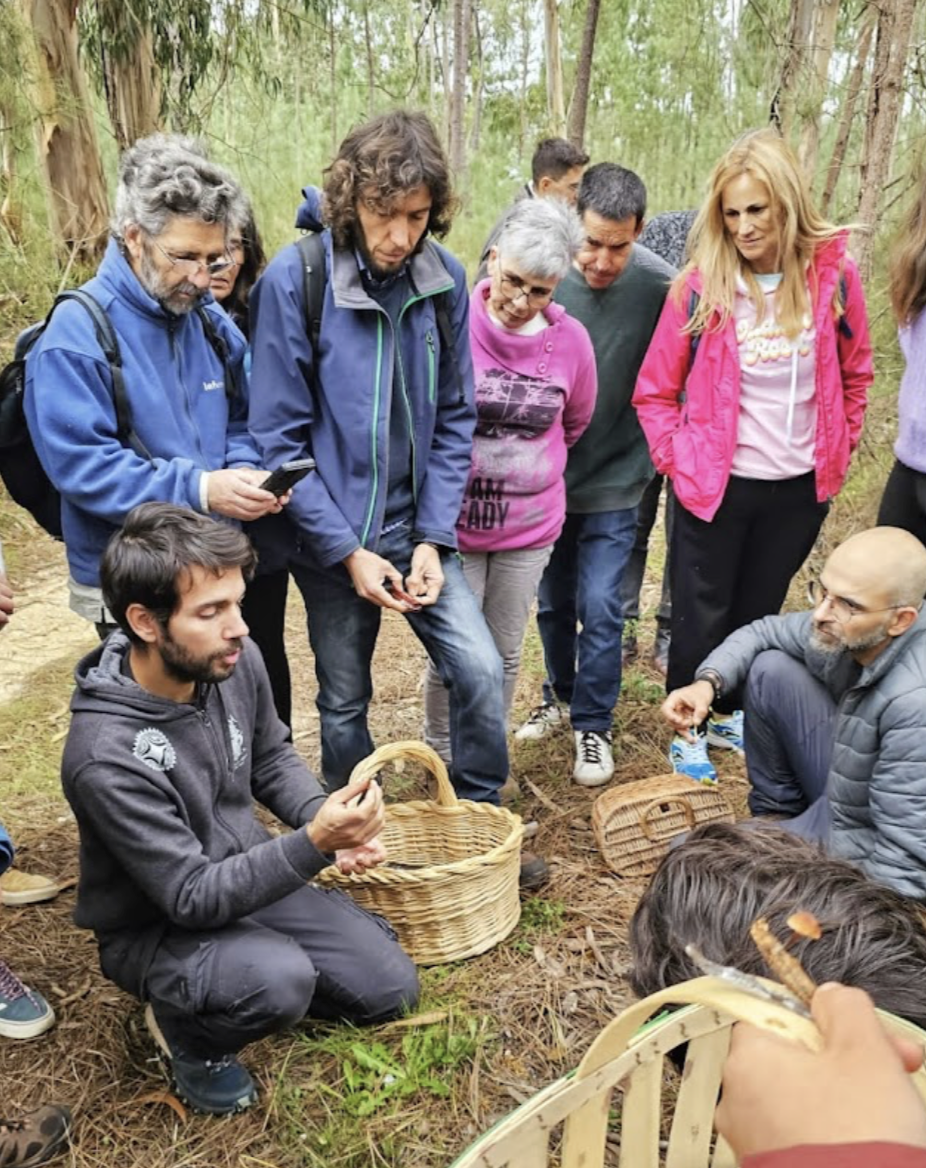
Community programming that has appeared across reviews and the farm's own materials includes: weekly yoga/pilates on the farm, mushroom foraging walks in the surrounding forests, climbing and outdoor activities in the Serra do Sicó, hiking and cycling routes through the Terras de Sicó region, cultural tours of Soure, Condeixa, Coimbra, and Pombal, pottery-making sessions, self-knowledge retreats and workshops, and long shared meals of garden-grown food. The weekly schedule is participatory rather than fixed — activities form around who is in residence and what is seasonally appropriate.
What People Say
Reviews for Quinta da Carvalheira are notable for their warmth and specificity — and for the frequency with which they mention wanting to return:
On arriving and feeling immediately held: "Staying at Quinta da Carvalheira was an unforgettable experience. From the moment I arrived, I felt fully immersed in nature — surrounded by open fields, free-roaming cats, chickens, and ducks that bring life and joy to every corner." — Verified Google reviewer, December 2025
"I spent two wonderful weeks here at Carvalheira!! The farm has a beautiful energy, created and cultivated by the people who live in and care for this place!" — Verified Google reviewer, December 2025
On the food and the garden: "Simone nourished us with her presence and her wisdom through delicious food!! It was also very healthy and fresh!! We spent days having deep and pleasant conversations, eating fresh food from the garden, and picking delicious figs and grapes!" — Verified Google reviewer, December 2025
"The Quinta's commitment to regenerative permaculture and sustainability is evident everywhere: from the layered garden beds to the meals prepared by Simone, using ingredients straight from their own garden. It's a place where nature, community, and learning coexist beautifully." — Verified Google reviewer, December 2025
On the community and transformation: "A Quinta da Carvalheira é sem dúvida um local de constante transformação interna e externa… Onde aparentemente não acontece nada, acontece TUDO e mais alguma coisa. Este lugar tem sido um refúgio ao longo destes últimos anos." [Quinta da Carvalheira is without doubt a place of constant internal and external transformation… Where apparently nothing happens, EVERYTHING and more happens. This place has been a refuge over these last years.] — Verified Google reviewer, October 2025
"The fact that this is more than just a physical place — it is a LIVING COMMUNITY — is the thing I keep coming back to." — Verified Google reviewer, October 2025
On activities and the landscape: "I participated in the mushroom foraging walk and loved it! Inês has created something very special at Quinta da Carvalheira. I will return!" — Verified Google reviewer, November 2025
On the energy and organisation of the space: "I stayed for a weekend at this beautiful Quinta. The house is clean, organized, and has a fantastic energy. I can't recommend this place enough to anyone who wants to unwind and experience nature." — Verified Google reviewer, October 2025
"Great experience at the quinta, super nice people and great atmosphere." — Verified Google reviewer, October 2025
On crafts and connections: "We also made pots together, always with a spirit of caring for one another. It was a rejuvenating and refreshing experience to be there. We will definitely see you again!" — Verified Google reviewer, December 2025
Critical notes worth including: Quinta da Carvalheira is a young coliving — it launched formally in October 2025 — and the operational patterns of a new space are visible in the details. The coworking setup is functional but not fully ergonomic for all work styles, and remote workers with specific desk-and-monitor requirements should verify current arrangements before booking. The space is small (7–10 residents maximum), which means community chemistry depends significantly on who else is in residence during any given period. Public transport is workable but requires engagement with bus schedules and advance planning for spontaneous city trips. The participatory household model — cooking rotas, shared cleaning — is a genuine feature of the experience and not optional: guests who prefer full-service hospitality should know this before arriving. And as with any project in its first year, the depth and consistency of programming that older colivings have accumulated will come with time.
The Experiences: Foraging, Trails, Permaculture, and the Terras de Sicó
The regional and on-farm programming at Quinta da Carvalheira draws on two distinct sources: the farm's own learning and regeneration programme, and the dense natural and cultural landscape of the Terras de Sicó and Coimbra region.
On-farm experiences that have featured regularly include: mushroom foraging walks in the surrounding forests, yoga and pilates in the farm grounds, pottery and craft sessions, permaculture introductions and garden work, self-knowledge retreats and coaching workshops led by Inês and visiting facilitators, and long shared meals cooked from the farm's own produce. These are not optional add-ons; they are the texture of daily life at the Quinta, available to all residents as part of the stay.
Outdoor and adventure activities accessible from the farm include: hiking trails in the Serra do Sicó, cycling routes through the Terras de Sicó (free bikes available on the farm), climbing at the outdoor walls and indoor gym at the Soure Climbing Centre (included, no extra charge), and exploring the Algarinho-Gramatinha-Ariques Ecological Park, where an oak and holm oak forest shelters over 800 wildlife species.
Cultural and regional exploration is rich from this base: Coimbra — one of Portugal's most culturally important cities, home to the Joanina Library (a UNESCO World Heritage Site), the old and new cathedrals, and the Fado de Coimbra tradition — is reachable by bus from the farm gate. The Roman Villa at Rabaçal and the Sicó Fossil Museum at Santiago da Guarda are within the immediate region. Condeixa-a-Nova, Pombal, and Conímbriga (among the best-preserved Roman ruins in Portugal, 16 km south of Coimbra) are all day-trip accessible without a car.
Pros & Cons
Pros
Authenticity of regenerative purpose. Quinta da Carvalheira is not a property that has adopted sustainability as a brand position. The land has been under active permaculture development since 2022, the food served is grown on site and sourced from neighbours, the spring water is from the farm, and the philosophical framework — three pillars of internal, community, and nature regeneration — is operative rather than decorative. This is among the most genuinely regenerative colivings in the Portuguese market.
Simone's kitchen is a community in itself. The consistent, specific warmth with which reviewers describe the food — not just as sustenance but as an act of care — is a meaningful signal. A communal kitchen that produces meals guests describe in terms of wisdom and nourishment is doing something that most colivings, regardless of budget, struggle to replicate.
The farmhouse and land are the real thing. A 17th-century working farm, fruit to pick from the trees, animals moving through the grounds, spring water, layered garden beds — this is not countryside as aesthetic. Multiple reviewers use the word "immersion" because there is nothing curated between them and the natural environment. That is a rarer offer than it sounds.
Remarkable value at the entry level. From €148/week for a dormitory bed in a functioning regenerative farm community near Coimbra, with meals, activities, coworking, yoga, bikes, and climbing access included, is a price point without obvious competition in the Portuguese market.
The team lives there. Inês, Simone, Ana, Hugo, and Luigi are not staff who commute in. They live on the property, participate in its daily life, and bring the energy that makes a household rather than a managed experience. This is the irreducible variable that colivings either have or don't, and Quinta da Carvalheira demonstrably has it.
Female-led and values-aligned. Founded and driven by Inês, the coliving has a clear ethical orientation around regeneration, community, and sustainability. For residents who care about the values of the spaces they inhabit, this is a meaningful differentiator.
Excellent bus access for a rural location. Bus 104 stops 400 metres from the farm gate, running between Pombal and Coimbra. For a rural farmhouse coliving, the public transport provision is meaningfully better than most equivalents.
The participatory model builds genuine community. The cooking rota and shared cleaning are not just practical arrangements — they are community-building mechanisms. Guests who engage with the participatory model tend to leave with the kind of connections that the coliving industry promises and rarely delivers.
Cons
Coworking ergonomics are not fully confirmed. The coliving.community listing flags that dedicated ergonomic chairs and monitors may not be available in all configurations. For remote workers who spend eight hours a day at a desk, this warrants a direct conversation with the team before booking.
A very young coliving. October 2025 is not very long ago. The operational rhythms, the consistency of programming, and the small refinements that accumulate over years of hosting are still developing. The fundamentals are strong — the land, the team, the philosophy — but the polish of an established coliving is not yet there.
Small scale means variable community. At 7–10 residents maximum, the social texture of any given stay depends almost entirely on who else is in residence. If the guest mix during your stay doesn't gel, there are very few people to fall back on. This is the double-edged nature of intimate community: extraordinary when it works, thin when it doesn't.
Participatory model is not for everyone. The cooking rota and shared cleaning are genuine expectations, not nominal gestures. Guests who want a fully serviced experience — show up, work, leave — are likely to find the household model friction-heavy rather than enriching.
Limited on-site dining options outside the community kitchen. Unlike Dolce Vita's village with two family trattorias at the door, Quinta da Carvalheira is a farmhouse. Soure's restaurants are 5 kilometres away. For those evenings when cooking or community dinner is not on the programme, the options require planning or transport.
Winter and off-season may be very quiet. A small farm in central Portugal in January, with a handful of residents, is a substantially different experience from the summer version. For guests who need social density to feel alive in a place, the quieter months at this scale of operation require realistic expectations.
How Quinta da Carvalheira Compares in the Rural Coliving Market
Factor | Quinta da Carvalheira | Rural Europe Coliving (avg.) | Urban Portugal Coliving |
Founding philosophy | ✓ Regeneration (land, community, self) | Environmental branding | Productivity / networking |
Land and food | ✓ Working farm, on-site produce | Garden as amenity | None |
Resident team | ✓ Lives on-site, multi-skilled | Manager on call | Staff, not community |
Entry price | ✓ From €148/week (dorm) | From ~€200/week | From ~€600/month |
Community model | ✓ Participatory household | Managed programming | Events-based |
Bus access | ✓ Route 104 at gate | Variable | Walking distance to transit |
Coworking ergonomics | Not fully confirmed | Varies | Usually good |
Capacity | 7–10 (micro) | 10–30 | 20–100+ |
Workshops/retreats | ✓ On-site, integrated | Rare | Very rare |
Female-led | ✓ Yes | Uncommon | Uncommon |
Quinta da Carvalheira does not compete with productivity-first colivings and does not try to. Its value proposition — a living, breathing regenerative farm where the quality of daily life is measured in the flavour of garden tomatoes, the weight of silence in the Serra do Sicó, and the depth of conversations over Simone's cooking — occupies territory that no urban coliving and few rural ones can credibly claim.
The Bigger Vision: Regenerating Rural Portugal
Quinta da Carvalheira's project is explicitly positioned within a broader problem: the depopulation and cultural hollowing of rural Portugal that has accelerated across several generations of urban migration. Inês's own story — growing up in Lisbon, returning to restore her family's land — is both personal and emblematic. Ana, the team member who grew up in Soure and chose to return, carries the same arc.
The project has a thesis embedded in it: that the knowledge, money, and energy of the urban professional class can be returned to rural places not as tourism but as genuine inhabitation — and that the regenerative framework is what makes that inhabitation meaningful rather than merely logistical. The coliving is not just accommodation for remote workers; it is, in the team's framing, an experiment in what rural Portugal can become when a new kind of inhabitant arrives with intention.
Staying at Quinta da Carvalheira in 2026 is participating in that experiment at an early stage. It is worth knowing before you book, because it changes what the experience means.
Frequently Asked Questions
What is a regenerative coliving? At Quinta da Carvalheira, regeneration operates across three dimensions: internal (personal growth, self-knowledge, coaching), community (shared living, local integration, mutual support), and nature (permaculture, organic growing, ecological practice). The coliving is embedded in this project rather than added onto it. Guests are not passive residents of a beautiful space; they are participants in a living community with an explicit purpose.
What is the minimum stay? The pricing structure is designed around week-long minimum stays, with longer-stay discounts available by enquiry. From €148/week (dormitory) or €339/week (private room). Monthly rates are approximately €555 (dormitory) or €1,290 (private). Contact the team to discuss your specific timeline.
What is included in the stay? Private room or dormitory bed, access to the coworking space with fibre Wi-Fi, all common areas, weekly room cleaning, garden produce and seasonal vegetables, community lunch cooking rota, weekly yoga/pilates, free bike use, free access to Soure Climbing Centre and outdoor climbing walls, participation in workshops and activities organised by the farm.
Is the internet reliable for remote work? Fibre internet is confirmed. The coworking area is a dedicated room. However, ergonomic chairs and monitors may not be available in all configurations — confirm directly with the team if this is a hard requirement for your work.
Can I get there without a car? Yes. Bus 104 (Pombal–Coimbra) stops 400 metres from the farm gate. Pombal connects by national bus (Rede Expresso, Flixbus) to Lisbon (~2h) and Porto (~1.5h). Coimbra is the nearer major hub, served by the same Bus 104 route. From Coimbra, train connections to the national rail network are available. Bikes are free for guests on the farm. For larger shops, community car runs operate once or twice weekly.
What is the community model? Participatory — meaning residents are expected to contribute to the household as well as benefit from it. This includes a shared cooking rota for lunches and shared cleaning responsibilities. The model is closer to a household than a hotel, and the community reflects that.
Is there a minimum commitment or trial period? The team recommends a conversation before booking — schedule one at calendar.app.google/tLWb2DFDRVezeNnb7 — to align expectations and ensure the fit is right. There is no stated happiness guarantee of the Dolce Vita variety, but the emphasis on pre-booking dialogue reflects the same intention: finding guests who will genuinely thrive in this environment.
Is the space open year-round? Yes. All four seasons, with the caveat that the experience in quieter winter months is substantially more focused and solitary than in the active summer period.
How do I book? Via quintadacarvalheira.com/en/coliving, by email at quintadacarvalheira10@gmail.com, or by WhatsApp at +351 915 717 510. The team encourages a conversation before booking.
Final Verdict: Is Quinta da Carvalheira Worth It?
For the right kind of resident — with some nuance about what right means here — yes, unambiguously.
Quinta da Carvalheira is not the easiest coliving to describe because it does not fit the standard template. It is not a productivity hub in a pretty location. It is not a wellness retreat with a desk in it. It is not a social club that happens to have a garden. It is a living farm community built around the proposition that regeneration — of land, of relationships, of the self — is a practice that requires daily engagement rather than a weekend retreat.
Simone's cooking, rooted in the farm's own soil and in decades of culinary and therapeutic wisdom, is not a feature. It is an argument that quality of life is edible. The mushroom foraging walks, the pottery sessions, the long conversations over shared lunches, the sound of ducks in the yard — these are not amenities. They are the facts of a specific kind of life, and for guests who have been looking for those facts, they are extraordinary.
The limitations are real. The coworking setup is not fully ergonomic for all. The community is small and its chemistry dependent on the particular mix of residents during your stay. The space is new, and the operational depth of an established coliving has not yet accumulated. The participatory model requires genuine participation. None of these are failures; they are the honest conditions of a real household, not a managed product.
For a remote worker in a period of transition — or a creative looking for grounded inspiration, or a professional who has told themselves they want to understand what sustainable living actually means rather than just endorse it from a distance — Quinta da Carvalheira is a direct argument that the countryside is not a retreat from your life. It is a place where a different version of your life is already happening, and you are invited to join it.
The garden figs are waiting. The Serra do Sicó trails start a short bike ride from the gate. Simone is in the kitchen with something from the garden, and Inês is probably in the orchard. Coimbra, with its 13th-century university and one of the most beautiful libraries in the world, is 45 minutes on the bus that stops 400 metres from the front door.
That is a very good deal for €339 a week.
Book your stay at Quinta da Carvalheira → 🌐 quintadacarvalheira.com/en/coliving 📍 Quinta da Carvalheira 10, Soure, 3130-600, Coimbra, Portugal 📞 quintadacarvalheira10@gmail.com | WhatsApp: +351 915 717 510
Last updated: 2026 | Based on firsthand research, site content from quintadacarvalheira.com, verified guest reviews from coliving.community and Google Maps, and independent regional guides for the Coimbra District, Soure municipality, and the Terras de Sicó.