Montino Coliving Review (2026): The Facilitated Mountain Coliving Over Lago Maggiore — Oggebbio, Northern Italy
Honest Montino Coliving review (2026). A renovated three-storey building in the pre-alpine village of Manegra, perched above Lago Maggiore in the Verbano-Cusio-Ossola region of northern Italy. Up to 20 guests across 4 room types — private en-suite, private shared bathroom, female dorm, mixed dorm. Starlink Wi-Fi, two dedicated coworking spaces, a 50sqm studio, large garden with hammocks, and a facilitated community programme with a manager on-site at all times. Breakfast included. From €800/month. This is what it's actually like.
What Is Montino Coliving?
There is a category of coliving that builds its identity around a building, and there is a category that builds it around the compound idea that where you live shapes how you think, how you work, and who you become while you're there. Montino Coliving belongs firmly to the second category — and the building it chose to occupy happens to be extraordinary.
Montino is a coliving space in the village of Manegra, in the municipality of Oggebbio, set in the pre-alpine hills of the Verbano-Cusio-Ossola province in northern Italy. It sits above Lago Maggiore — Italy's longest lake, the second largest in the country, stretching 64 kilometres from Arona in the south to Locarno in Switzerland at the north — on a hillside surrounded by chestnut forests, mountain trails, and a cascade of lake and mountain views that guests have, with some consistency, described as the kind of thing you stop believing is real after the first few days and simply begin to live inside.
The coliving operates from a renovated three-storey building, accommodating up to 20 people across four room configurations: private en-suite rooms, private rooms with shared bathrooms, a female dormitory, and a mixed dormitory. The building includes two dedicated coworking spaces (one quiet, one social), a large shared living room that doubles as a community events space, a 50sqm studio for yoga, movement, and workshops, a professional kitchen, a garden with hammocks and a fire pit, and two terraces. The internet is Starlink. Breakfast is included. A community manager is on-site at all times.
The address is Strada Luigi Cadorna no. 26, Manegra, 28824 Oggebbio VB, Italy. The company behind it — Montino SRL, registered in Milan — has been operating since 2024, and the coliving has in that time accumulated a body of guest reviews that is notably consistent: guests do not come expecting Italy and find a coliving. They arrive expecting a coliving and find, somewhere around day three, that the Italy keeps interrupting their working day in the best possible way.
This review tells you what that means in practice — including the things the website doesn't spell out.
Montino Is Best For
✓ Remote workers and digital nomads who want to work properly — dedicated ergonomic spaces, Starlink connectivity, a culture of focus — while living inside one of northern Italy's most genuinely beautiful landscapes ✓ Solo travellers who want a warm, active community without being required to perform sociability — the facilitated model means events exist and opt-in is real ✓ Groups of any size, up to 20: whether a team retreat, a friend group, or a gathering of strangers who become something else by the end of the first communal dinner ✓ People who value Italy specifically: the food, the wine, the slow pace of lakeside village life, the morning espresso, the ferry to the Borromean Islands on a Saturday, the local restaurant five minutes down the road ✓ Guests who want a community manager on-site rather than a booking platform and a keybox — someone who organises, connects, and knows the region ✓ Travellers drawn to nature who want hiking, swimming, and forest access as daily options rather than weekend excursions ✓ Those seeking a transition between the pace of city life and something more considered — Montino's own tagline captures it exactly: "Fast Wi-Fi, slow living" ✓ Wellness-oriented remote workers for whom daily yoga, meditation, and access to a movement studio are part of a functioning week, not an occasional treat
Book a stay at Montino Coliving → 🌐 montino.life 📍 Strada Luigi Cadorna no. 26, Manegra, 28824 Oggebbio VB, Italy 📧 info@montino.life 📞 +39 351 302 4101 (WhatsApp) 📸 @montinocoliving 🗓️ Book via: montino.life/book 🏷️ Early-bird 2026 promo: 15% off with code EarlyBird2026
Why Montino Is Different
The easiest comparison for Montino is to other Italian colivings — and there are now several, clustered mostly around Rome, Florence, and Tuscany, offering the standard proposition of good food, charming surroundings, and a remote-work-compatible environment. Montino does not sit in that geography, and the difference is not merely locational.
The Verbano-Cusio-Ossola region — the provincial territory bounded by the Swiss Alps to the north and Lago Maggiore to the south — is not where most digital nomads think to go. The lake is well-known as a holiday destination for northern Europeans and wealthy Milanese, but it has not developed the nomad infrastructure of a Lisbon, a Madeira, or a Palermo. There is no coworking hub in the town of Oggebbio. There is no nomad Slack group for Verbania. What exists instead is a landscape that Lonely Planet describes as "the most peaceful of northern Italy's great bodies of water, its shores a little less crowded and its hinterland intriguingly wilder" — and a coliving that has planted itself inside that landscape with deliberate intent.
The structural distinction that separates Montino from most comparable colivings in the alpine/pre-alpine European category is the facilitated community model. "Facilitated" is a word that can mean many things, but at Montino it has a specific definition: a community manager is on-site at all times, curating the activity and events calendar, organising and leading community experiences, and ensuring that the social fabric of the house does not depend entirely on who happened to book that week. This is a meaningful operational choice. It means that guests arriving alone, or arriving in an unfamiliar country, or arriving mid-week when the house is quiet, are not left to generate their own community from scratch. The evening skill-share, the communal dinner, the forest walk on Sunday — these happen because someone at Montino is responsible for making them happen.
The second structural distinction is the building itself. Montino is not a converted farmhouse, a repurposed hostel, or a large villa divided into rooms. It is a three-storey renovated building with a 50sqm dedicated studio — a space large enough for a yoga class of twenty people, a workshop, a film screening, or an indoor movement session — alongside two separately configured coworking areas, a professional kitchen, a large living room, a garden, and terraces. The build-out reflects genuine investment in what a multi-week stay requires for both productivity and community: not a single table with good Wi-Fi, but multiple spaces calibrated for different working moods, social intensities, and activities.
The third distinction is Italy. This sounds obvious, but it is not decorative: the specific inflection of Italian life in the Verbano-Cusio-Ossola region — the family-run restaurant five minutes down the road with wood-fired pizza from €7, the weekly markets in Verbania, the local vineyard open for weekend tastings, the Borromean Islands accessible by ferry, the fresh pasta, the espresso culture that is not a lifestyle choice but simply what breakfast is — all of this is woven into the Montino experience in a way that requires presence to understand and photographs to inadequately approximate.
The Location: Lago Maggiore and the Pre-Alpine North
Lago Maggiore is Italy's longest lake and its second largest, stretching for 64 kilometres from its southern reach near Arona northward until it crosses into Switzerland at Locarno. It is one of three great Italian pre-alpine lakes — the others being Como and Garda — and is generally considered the least crowded and most peacefully scenic of the three. Lonely Planet notes that it is "free of Como's overt glamour" and characterised by a hinterland that is "intriguingly wilder" than its more famous counterparts. The lake's western shore, where Montino sits, is Piedmontese territory; the eastern shore belongs to Lombardy; the northern tip is Swiss.
The Verbano-Cusio-Ossola province in which Oggebbio lies occupies the triangle between the lake, the Swiss Alps, and Val Grande National Park — Italy's largest wilderness area, described as entirely unpopulated and covering some of the most untouched landscape in the Alpine arc. The region's climate is mild relative to the Alpine norm: the lake moderates temperature in both summer and winter, producing what Italy's tourism authorities describe as "Mediterranean vegetation," and the area is sheltered from cold northern winds by the surrounding peaks. Summer temperatures are warm (often 25–30°C) and reliably sunny; autumn brings dramatic colour to the chestnut forests that surround the coliving; winter is cooler but productive for focused work, with snow-dusted mountains visible from the terrace.
Montino's specific position — in the hamlet of Manegra, within the municipality of Oggebbio — places it on a hillside above the lake, in one of the region's quieter and less touristed zones. The municipality of Oggebbio extends across 15 villages and some 900 permanent residents; Manegra is among the hillside hamlets, connected to the lakeside and the larger town of Verbania by a combination of mountain road, bus service, and — for guests with good legs and patience — a hiking path down to the water. A local reviewer described the approach to the area as feeling like "a picture-perfect little village, where every ride feels like a postcard." This is not hyperbole.
The nearest city of any practical consequence is Verbania (also known as Intra or Pallanza in its different neighbourhoods), approximately 25 minutes by car or bus, and by some accounts the most pleasant lakeside city in northern Italy — a characterisation that its promenade, botanical gardens at Villa Taranto, and concentration of restaurants and service infrastructure seem to support. Stresa, the region's most famous tourist town and departure point for Borromean Island boat tours, is approximately 30 minutes further south by car or ferry.
Destination | Journey |
Verbania / Intra (nearest city) | ~25 min by car / bus (several times daily) |
Ristorante Pizzeria al Sole (nearest restaurant) | ~5 min by car / ~1hr walk |
Lake beaches (Suna, Ghiffa) | ~15–20 min by car |
Stresa (Borromean Islands ferry) | ~30 min by car or lake ferry |
Val Grande National Park | ~30 min by car |
Lago Maggiore Zipline | A few min by car |
Verbania-Pallanza train station (pickup available) | ~25 min |
Milan Malpensa Airport (MXP) | ~1.5 hours by car |
Milan Bergamo Airport (BGY) | ~2 hours by car |
Milan Centrale (by train from Verbania) | ~1.5–2 hours |
Getting to Montino without a car is entirely feasible: a direct shuttle service runs from Milan Malpensa Airport to Verbania-Intra, and Trenord trains connect Milan Centrale to Verbania-Pallanza. Montino offers free pickup from both Verbania and Verbania Pallanza stations — a practical hospitality detail that removes the friction of arriving in an unfamiliar mountain region without transport. For those who prefer to drive, the A26 motorway connects Milan to the lake in under an hour, and car rental is available at both airports.
The Space: A Renovated Alpine Building Designed for Both Work and Community
Montino operates from a single renovated three-storey building in Manegra — not a compound, not a distributed set of properties, but a coherent structure that has been reconfigured to serve the specific dual requirement of a functioning coliving: productive work infrastructure and genuine community space.
The building has clearly been built with scale in mind. At capacity it houses up to 20 people — a size large enough to generate consistent social energy without losing the intimacy that makes coliving different from a hotel. The room configuration allows guests with different budgets and social preferences to find the right fit. The community infrastructure — the studio, the living room, the garden, the kitchen — is designed for the full group, not for a small cluster.
The Coworking Spaces are one of Montino's most practically differentiated features. Rather than a single open-plan table with a power strip, Montino provides two separately configured workspaces: one described as "quiet," calibrated for focused deep work; and one described as "social," for collaborative sessions, casual calls, or the kind of working-alongside-others that many remote workers find productive without being isolating. Both are equipped with ergonomic chairs, power sockets, and USB chargers. The living room provides a third, more informal working environment with communal tables — the kind of space where you might shift mid-morning from a desk to a sofa and find your productivity follows you. All rooms include a dedicated table and chair, making in-room work a real option for guests who need full privacy.
The Starlink satellite internet connection deserves specific mention. In a mountain village that sits above a lake, 25 minutes from the nearest city, standard Italian fibre provision is not guaranteed. Starlink bypasses the local infrastructure question entirely — and multiple independent reviews across platforms note the internet's reliability for video calls and full remote working use, without reported outages or speed concerns.
The 50sqm Studio is the building feature that most clearly signals Montino's investment in the wellness and community programming side of the offer. A 50sqm dedicated indoor space — the equivalent of a small yoga studio, a seminar room, or a workshop hall — is unusual in a coliving at this price point, and its existence is not decorative: the studio is used for the yoga, Pilates, and meditation classes that are part of Montino's regular programming, for skill-share evenings and workshops, and for any large-group indoor gathering that the living room cannot comfortably accommodate.
The Living Room and Communal Dining Area forms the social heart of the building — a large, flexible space with comfortable seating and communal tables, used for shared meals, board games, evening events, and the informal daily gathering that forms the background texture of a functioning community. Multiple reviews describe the communal dinners here as the moments at which the community actually became a community: the point at which strangers from different countries and careers stopped being housemates and started feeling like something closer.
The Kitchen is described on the retreat page as "professional" and "restaurant-ready equipped" — a meaningful claim in a building that is also offered for group retreats and events of up to 18 people. For coliving guests, it is a fully shared space with the infrastructure to cook for large groups: large fridges, substantial storage, full equipment. Montino provides a starter selection of basic ingredients — pasta, olive oil, rice, condiments, eggs, bread, dairy alternatives, and cheese — which amounts to a practical subsidy on self-catering and ensures guests can cook immediately on arrival without a supermarket run. Breakfast is also included in the accommodation price.
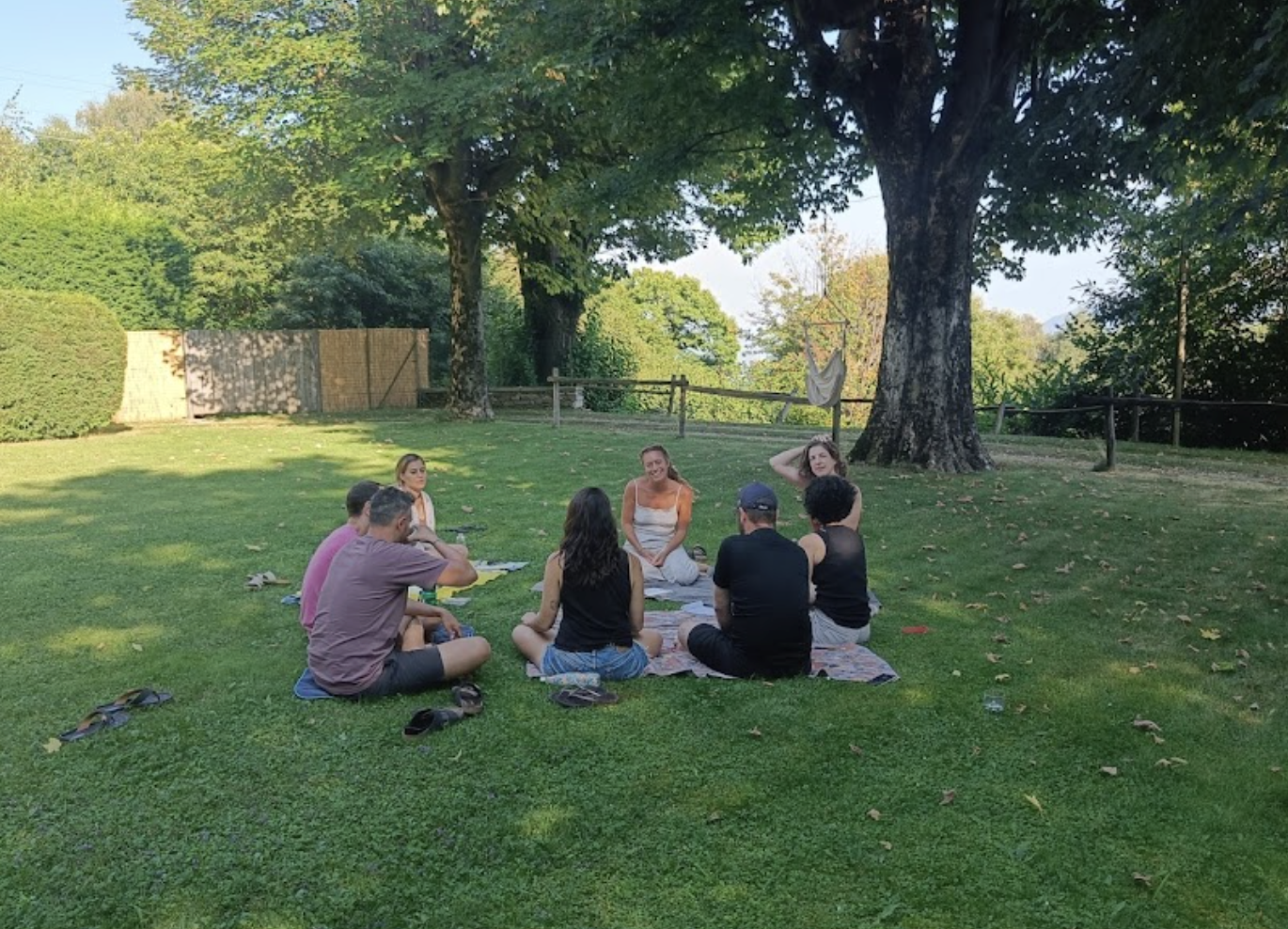
The Garden is large, grassed, equipped with hammocks, benches, and a fire pit, and oriented toward mountain and forest views. The garden serves as an outdoor coworking option in good weather (the large shaded area is specifically noted for summer working), a social gathering space for evening fire pit sessions, and the kind of outdoor room that most urban colivings cannot offer at any price. Reviews from guests who stayed in summer describe the garden as the default destination between work sessions.
The Terraces provide the building's most direct visual engagement with the landscape — the lake views, the mountain backdrop, the chestnut forest immediately around the property. These are working and relaxing spaces, and the combination of indoor/outdoor transitioning they enable — desk to terrace to garden to studio — is one of the things that makes a multi-week Montino stay structurally different from a multi-week solo apartment in an Italian city.
Pets and vanlife are both explicitly welcome — a detail on the website that is unusual and signals something about the operational flexibility of the space. A car park accommodates vans. The pet-friendly designation removes a common source of friction for remote workers who travel with animals.
Supermarket deliveries are available twice a week from Esselunga in Verbania (including online ordering with delivery to Montino), which means guests without cars can maintain a well-stocked kitchen without depending on the bus schedule.
The Rooms: Four Configurations, One Building
Montino can accommodate up to 20 guests across four room types, designed to serve different budget levels and privacy preferences:
Private En-Suite Rooms — The premium option: private room with en-suite bathroom, dedicated work desk, and fast internet. The fully independent configuration — no bathroom sharing, complete privacy outside of communal areas. Ideal for guests who want the community experience without any compromise on personal space.
Private Rooms with Shared Bathroom — Private sleeping and working space, with shared bathroom facilities. The mid-range configuration and the most common choice for solo remote workers who value a quiet retreat to their own room but are comfortable sharing bathroom infrastructure.
Female Dormitory (3 beds) — A shared sleeping space for up to three women, offering the most social in-room experience and the most accessible price point.
Mixed Dormitory (4 beds) — A four-bed mixed dorm, the most affordable option, suited to guests who prioritise community and cost efficiency over privacy.
All rooms, regardless of type, include access to the dedicated work desk setup and fast Starlink internet, the full common areas (both coworking spaces, living room, studio, kitchen, garden, terraces), all community programming, and the included breakfast. The quality of the work and social infrastructure does not scale with room type — the dorm guest and the en-suite guest share the same coworking spaces, the same studio, and the same communal meals.
Pricing:
From €800/month (confirm current rates and availability by room type directly with the team)
2026 early-bird promotion: 15% off with code
EarlyBird2026
at booking
Breakfast is included in all stays
No stated minimum stay on the site; contact directly to confirm current minimum
Cancellation policy:
Full refund if cancelled more than 21 days before check-in
50% non-refundable if cancelled between 48 hours and 21 days before check-in
50% refund if you arrive and depart early (for nights not spent, calculated 24 hours after cancellation)
No-shows: full price charged
Booking is handled via montino.life/book, with a credit card charge applied within 21 days of check-in. A €100 pre-authorisation hold is placed at check-in and returned within 3–10 business days depending on the guest's bank.
The Community: Facilitated, On-Site, and Genuinely Active
The defining operational characteristic of Montino's community model is the phrase it uses on its own Q&A page: "Montino is a facilitated community, meaning we always have a community manager on site, curating content and activities for our residents."
In the coliving industry, community is the most commonly over-promised and under-delivered element of the product. Many colivings describe themselves as "community-focused" while their community programming amounts to a WhatsApp group and whoever happens to show up for a weekly dinner. Montino's model is structurally different: the community manager is not an optional position or a task shared among rotating staff — it is a permanent, on-site role, present daily, actively curating both the activity calendar and the social conditions that allow a group of strangers to become something cohesive.
The practical output of this model is visible in what the programming calendar reliably includes: weekly skill-share evenings (the site explicitly invites guests to bring their own expertise to share with the group — "everything and everyone is welcome"), communal meals prepared in the shared kitchen, Italian language and cooking classes, yoga and Pilates sessions in the studio, meditation sessions, forest walks, hikes into the surrounding mountains and lake trails, group excursions to Verbania, Stresa, and the Borromean Islands, and board game nights and social evenings that require no planning on the guest's part except the decision to show up.
The skill-share model is worth dwelling on specifically. Most coliving community events are consumed passively: attend a talk, join a hike, eat dinner. Montino's explicit invitation to guests to contribute their own content creates a different dynamic — one where the community's value is partly generated by the community itself, and where a software engineer, a photographer, a language teacher, and a nutritionist in the same house each has something to offer the group beyond their company. This is a meaningful difference in how community feels over multiple weeks.
Independent guest reviews across multiple platforms (coliving.community, Coliving Compass, Trustindex, coliving.com) are consistent enough to be notable for a coliving that opened in 2024. The recurring themes are: the quality of the community (not just the activities, but the specific people who chose Montino), the effectiveness of the communal meals and events as bonding mechanisms, the balance between privacy and connection, and the role of the surrounding Italian landscape in giving the community shared experiences — hikes, ferry trips, dinners in Verbania — that build the texture of a real shared life rather than a coordinated set of amenities.
One guest described it as "like joining a small commune, or even a kibbutz, just for a short while." Another noted that despite staying only a month, they felt they had "made friends for life." A third, after seven months of solo nomading, found Montino to be the first coliving that "felt like home." These are not outlier reviews — they are the median.
What People Say
Montino has accumulated a meaningful body of independent reviews across platforms since opening in 2024, with a 4.2-star aggregate rating on Trustindex from over 135 reviews — a significant volume for a coliving that had been operating for under a year at the time of compilation.
On the community:
"The sense of community is amazing. I met some truly wonderful people, and even though we only spent about a month together, I feel like I've made friends for life. The communal dinners, yoga sessions, fun outings and just hanging out together, really helped us bond." — Anat, August 2024
"Being surrounded by like-minded digital nomads, working in a comfortable space, sharing fun communal meals and deep conversations about life, business, and family. It was an amazing experience! And all of it surrounded by nature." — May 2025, coliving.community
"This was the first co-living I've ever been to. After nomading for 7 months, Montino felt like home. The community, the staff and the owners were so great — I was sad to leave." — November 2024, coliving.community
"Staying here is like joining a small commune, or even a kibbutz, just for a short while. You have your own private space and you can always find the peace and quiet you need, but there's always the chance to mingle and never feel alone." — September 2025, coliving.community (family group, 9 people, ages 10–75)
On the work infrastructure:
"Fantastic spot for remote workers looking for both productivity and relaxation. Beautifully renovated space with fast Wi-Fi and quiet work areas. Easy to focus." — Tamir, September 2024
"The workspaces are thoughtfully designed, providing both quiet and comfort, with reliable, high-speed internet that made my workdays smooth." — coliving.community, November 2024
On the location and experience:
"The house is located in a fairytale alpine landscape. From the house we set off on the mountain roads to the surrounding towns, as we marvelled at the breathtaking green landscape and the unique houses planted in it." — September 2025
"In the mornings, before everyone else woke up, I found the workspace peaceful and loved being able to work quietly. Montino sits in a remote spot on a hill, overlooking the incredible [lake]. It's nestled in a picture-perfect little village, where every ride feels like a postcard." — Coliving Compass
"Even though it rained and stormed for much of our stay, we shifted our plans and still had a fantastic time. We enjoyed exploring Verbania, riding the ferries, touring the islands (don't miss the palace!), and eating our way through the local spots." — Coliving Compass
Critical notes worth including:
The remoteness of Manegra is described consistently — and without complaint — by guests who arrived knowing it and embraced it. The same remoteness would be a problem for guests who did not. The bus from the village to Verbania runs several times daily but is not always convenient; a rental car significantly expands independence. The Hostelworld listing notes the car as "the most convenient option since the nearest grocery store is a bit far." This is honest: Montino is a mountain village, not a city neighbourhood.
The dorm accommodation, while priced to provide access at lower budgets, is less frequently the subject of specific praise than the private room configurations. For guests who are light sleepers, have early or late work schedules, or simply value uninterrupted mornings, the dorm configuration comes with the standard caveats that apply to any shared sleeping arrangement.
Montino was a hotel and restaurant before it became a coliving, and some older reviews on aggregator platforms predate the coliving operation entirely — the trustindex.io listing itself notes this. Prospective guests researching the property should filter for reviews dated from mid-2024 onward for an accurate picture of the current experience.
Italy's broader digital nomad visa landscape is still developing. Italy launched a Digital Nomad Visa in 2024, but its requirements (minimum income thresholds, health insurance, proof of accommodation) and processing timeline mean it is more practical for longer-term stays than short coliving visits. EU citizens have no restrictions. Non-EU guests planning stays beyond 90 days should research current visa requirements directly.
The Experiences: Alpine Wilderness, Lake Life, and Everything Italian
Montino's activity proposition draws on three distinct sources: the in-house community programming run by the community manager, the natural environment immediately outside the front door, and the wider Verbano-Cusio-Ossola region with its towns, islands, food, wine, and cultural infrastructure.
In-House Programming (weekly or regular, included in the stay): Yoga, Pilates, and meditation classes in the 50sqm studio; skill-share evenings where guests teach each other professionally and personally; Italian language and cooking classes; communal kitchen dinners; board games and social evenings; forest walks and short hikes; and facilitated community excursions organised by the community manager. The programme evolves with the guests — the explicit invitation for guests to contribute their own content means the calendar reflects the particular mix of people in residence at any given time.
Nature and Outdoor Activities: Hiking begins directly from the building — forest trails into the chestnut woods, mountain paths with lake views, and routes of increasing difficulty up toward the peaks of the Verbano-Cusio-Ossola ridge. Val Grande National Park, the largest wilderness area in Italy, is a short drive away and offers full-day trail experiences in genuinely remote alpine terrain. AllTrails lists numerous trails accessible from the Oggebbio area, ranging from easy lakeside walks to multi-hour mountain ascents. Lake swimming is available at several beaches within 15–20 minutes by car: Suna Beach in Verbania (with full beach amenities), Ghiffa Beach (known for clear water), and the more intimate Cannero Riviera beach further north. The Lago Maggiore Zipline — described as an "extreme attraction" — operates a few minutes from the coliving for guests who want a more dramatic engagement with the lake view.
Towns, Culture, and Food: Verbania (25 minutes by car/bus) is the region's main city and the base for practical needs — supermarkets, pharmacies, banks, restaurants, cafés, and the lakeside promenade. Villa Taranto, one of Italy's finest botanical gardens with over a thousand plant species, is located in Verbania and accessible as a half-day trip. Stresa (30 minutes south) is the departure point for boat tours to the Borromean Islands — Isola Bella with its baroque Palazzo Borromeo and terraced Italian gardens, Isola Madre with its botanical estate, and Isola dei Pescatori, an inhabited fishing village preserved essentially unchanged since the 19th century. These islands are among the most consistently acclaimed visitor experiences on the entire Italian lake circuit, and they are a ferry ride from Montino's nearest town.
The food and wine landscape of the Verbano-Cusio-Ossola region is everything the Italian context promises. Five minutes from the coliving by car, Ristorante Pizzeria al Sole is a family-run trattoria serving wood-fired pizza from €7 and full Italian menus including fresh pasta, seafood, and tiramisu. The closest vineyard — Azienda Vitivinicola Edoardo Patrone — is open for weekend tastings. Verbania's markets and the Esselunga supermarket (with delivery to Montino twice weekly) provide access to the full range of northern Italian produce. Guests who have stayed have used words including "foodie's heaven" and "heaven for anyone who loves eating and drinking well" — which, in the context of a coliving above Lago Maggiore with a community kitchen and regular communal dinners, is both accurate and slightly understated.
Pros & Cons
Pros
Facilitated community with a permanent on-site manager. This is Montino's most significant operational differentiator. A community manager is present every day, curating activities, facilitating introductions, and ensuring the community programming actually happens regardless of who is booked that week. For solo travellers arriving with no existing network, this is not a small thing — it is the mechanism that turns a building full of remote workers into something that feels, by most accounts, like home.
Scale that generates genuine social energy. At up to 20 guests, Montino sits at the optimum scale for coliving community: large enough that there are always interesting people around, small enough that you learn everyone's name. The four-room-type model means the community draws guests across a range of budgets and backgrounds, which tends to produce more interesting dinner-table combinations than a uniform price-point approach.
The 50sqm dedicated studio. Rare at this price point, and genuinely used: yoga, Pilates, skill-shares, workshops, and group events happen in a space designed for them, not in a cleared-out living room. For guests who value regular movement practice, this inclusion is substantive.
Two differentiated coworking spaces. The quiet/social distinction between the two workspaces is a practical acknowledgment that different kinds of work — deep concentration versus collaborative calls — require different environments. Few colivings at this price point make this distinction explicitly in their infrastructure design.
Starlink internet in a mountain village. The connectivity question for any rural or pre-alpine coliving is real, and Starlink resolves it cleanly. Reviews do not identify internet reliability as a concern, which in a mountain village above a lake is the most positive thing that can be said about the connectivity provision.
Italy, specifically this Italy. The Verbano-Cusio-Ossola region does not appear on most nomad route maps, which is precisely why the guests who do arrive tend to describe the landscape, the food, and the lake as revelatory rather than anticipated. The combination of alpine wilderness, Italian lake culture, and proximity to one of Europe's most dramatic collections of baroque island architecture (the Borromean Islands) is not replicated anywhere else.
Breakfast included. A detail that most colivings omit and that, for anyone who has experienced the particular quality of an Italian morning — espresso, bread, local honey, the sound of the valley waking up — is not a minor amenity.
Pet-friendly and vanlife-friendly. Both explicitly accommodated. For a significant subset of remote workers, these are not nice-to-have details but decisions about whether a booking is possible at all.
Retreat-ready infrastructure. The Montino Retreat Home offering — full buyout for groups up to 18, chef-prepared meals on request, configurable spaces, team transfers — means the building has been designed with group events in mind. For companies considering a workation retreat, the infrastructure exists and the team has experience delivering it.
Cons
The location requires a car for full independence. Montino is explicit about this, and reviewers confirm it: a bus runs from Manegra to Verbania several times daily, and free pickups from the train station are available on arrival, but day-to-day freedom — spontaneous evening trips to Stresa, weekend excursions into Val Grande, accessing lake beaches at the moment the sun appears — is significantly greater with a rental car. Guests without a car can manage, but they will be more dependent on scheduled transport and community car-sharing.
Dorm accommodation has the standard shared-sleeping caveats. The female and mixed dorms expand affordability but come with the noise, schedule misalignment, and privacy trade-offs of any shared sleeping arrangement. Guests who are light sleepers or have early morning deep-work routines should weigh this honestly. The private room configurations resolve the concern entirely.
The region is not a nomad hub. There is no established digital nomad community in Oggebbio or Verbania, no regular nomad meetups, no external coworking spaces to step into. The social life of a Montino stay is almost entirely contained within the coliving itself and the activities the community manager organises. For guests who value external nomad networking — attending events, joining city-level Slack groups, bumping into people from other colivings — this will feel limiting. For guests who want immersion in Italian life rather than immersion in nomad culture, it is exactly right.
Verbania's infrastructure, while adequate, is modest. The nearest city is pleasant but not a major metropolitan centre. Guests accustomed to urban-density coworking hubs, extensive restaurant rotation, or a full spectrum of city amenities will find Verbania's offering limited compared to a Funchal or a Lisbon. The twice-weekly Esselunga delivery service mitigates the supermarket distance, but it is not the same as walking to a market.
No published minimum stay information. The website does not specify a minimum stay clearly, and the booking calendar shows variable availability. Guests planning very short stays (under a week) should confirm directly — the coliving's community model works best with a stay long enough to participate meaningfully in the rhythm of the house, and the team may have preferences around this.
Italy's Digital Nomad Visa is a work in progress. Non-EU guests planning stays longer than 90 days face a visa landscape that is technically available (Italy introduced a Digital Nomad Visa in 2024) but practically demanding in its requirements. EU citizens are unaffected. Non-EU guests should research current requirements directly and plan accordingly.
How Montino Compares in the Wider Coliving Market
Factor | Montino Coliving | Italian Urban Coliving (avg.) | Pre-Alpine / Mountain Coliving (EU) |
Permanent on-site community manager | ✓ Yes | Rarely | Rarely |
Dedicated movement/yoga studio | ✓ 50sqm studio | No | Occasionally |
Dual coworking spaces (quiet + social) | ✓ Yes | Often single space | Sometimes |
Max capacity | ~20 guests | 10–30 | 8–15 |
Room type variety | ✓ 4 types (en-suite to dorm) | Usually 2–3 | Usually 2–3 |
Breakfast included | ✓ Yes | Sometimes | Sometimes |
Starlink internet | ✓ Yes | No (fibre standard) | Sometimes |
Car needed | Recommended | No | Often yes |
City access | ~25 min to Verbania | In-city or walking | 20–45 min |
Retreat buyout offering | ✓ Yes, up to 18 pax | Rarely | Occasionally |
Pets and vanlife welcome | ✓ Both | Rarely | Sometimes |
Early-bird 2026 discount | ✓ 15% (EarlyBird2026) | N/A | N/A |
Price from | ~€800/month | ~€900–1,500/month | ~€700–1,200/month |
Borromean Islands day trip | ✓ ~30 min by ferry | No | No |
Montino's combination of community management infrastructure, physical amenity scale (studio, dual coworking, garden), and Italy-specific location is not replicated precisely anywhere else in the pre-alpine coliving market. The nearest comparable proposition would be a wellness retreat with coworking, but at a community-stays price point and with a nomad-focused culture rather than a programme-defined itinerary.
The Bigger Vision: Slow Living With Fast Wi-Fi in an Italy Most Nomads Miss
The Montino tagline — "Fast Wi-Fi, slow living" — is one of the more honest self-descriptions in the European coliving market. It makes a specific promise: that the work infrastructure will not be compromised (Starlink, ergonomic spaces, dedicated quiet zones), and that everything around the work will actively encourage a different pace. This is not a promise that all colivings make or mean. At Montino, the mountains, the lake, the Italian food culture, the community manager who organises Wednesday evening pasta-making, and the fire pit in the garden combine to make it structurally true.
The Mapmelon listing includes a fragment of context from the hosts that is worth noting: "We are all digital nomads for many years and we wanted to have a good base and host many people we met." This is a founder story in one sentence — people who lived the nomad life long enough to understand what they wished existed, and who built it in the part of Italy they loved. The result is a coliving that does not feel designed for a market segment but built for a specific kind of experience that the founders understood from the inside.
The Verbano-Cusio-Ossola region is not on the standard nomad map. It does not have a digital nomad visa programme or a co-founder ecosystem or a monthly meetup where you can network with forty other remote workers. What it has is chestnut forest, lake ferries, a local restaurant where the pizza comes out of a wood oven at €7, and a horizon that, on a clear evening from the Montino terrace, includes both the Alps and the water and a sky that does what Italian skies do at sunset.
Montino exists to put remote workers inside that horizon for a month at a time. The community manager ensures no one spends the month alone. The studio ensures no one's body stiffens into a desk posture. The Starlink ensures the clients don't notice you've moved to a mountain village. And the fire pit in the garden ensures that at least some evenings end with a group of strangers around a fire, speaking several languages, wondering why more people don't already know about this place.
They will. But for now, it remains one of the quieter secrets of the European coliving market — and that, for the right guest, is half the point.
Frequently Asked Questions
What is included in the Montino stay? Private or shared room with a dedicated work desk, access to both coworking spaces, the living room, the 50sqm studio, the garden, and terraces. Starlink Wi-Fi throughout. Breakfast (with fresh Italian coffee) is included. Basic kitchen ingredients (pasta, olive oil, rice, condiments, eggs, bread, cheese, and more) are provided. Weekly community activities including skill-shares, communal meals, yoga, Italian language and cooking classes, hikes, and more are organised by the on-site community manager.
What room types are available? Four configurations: private en-suite rooms (5 rooms), private rooms with shared bathrooms (5 rooms), a female dormitory (3 beds), and a mixed dormitory (4 beds). All room types include a dedicated work desk and Starlink internet access.
Is the internet reliable for remote work? Yes. Starlink satellite internet is used throughout the building. Multiple independent guest reviews confirm the connection's reliability for video calls, large file transfers, and full remote working use.
Do I need a car? A car is strongly recommended for full independence. A bus runs from Manegra to Verbania (the nearest city) several times daily, and free pickups are available from Verbania and Verbania-Pallanza train stations. The twice-weekly Esselunga supermarket delivery service means groceries do not require a car trip. For exploring the wider region spontaneously — Val Grande National Park, Stresa, the Borromean Islands by road, lake beaches — a rental car is the most practical option.
How do I get there? The closest airport is Milan Malpensa (MXP), approximately 1.5 hours by car. A direct shuttle service runs from MXP to Verbania-Intra (book via safbooking.com/alibus). Trenord trains run from MXP to Milano Centrale, with a connection to Verbania-Pallanza. Milan Bergamo Airport (BGY) is approximately 2 hours by car, with a connecting train via Milan Centrale. Montino provides free pickup from both Verbania and Verbania Pallanza stations — contact the team to coordinate.
What is the minimum stay? Not formally stated on the website. Contact Montino directly at info@montino.life or via WhatsApp at +39 351 302 4101 to confirm current minimum stay requirements and availability.
What community activities are available? Regular programming includes yoga, Pilates and meditation sessions in the studio, weekly skill-share evenings, communal kitchen meals, Italian language and cooking classes, forest walks, group hikes, excursions to Verbania and the Borromean Islands, and board game and social evenings. The calendar evolves based on who is in residence — guest-contributed content is actively encouraged.
Are pets and vans welcome? Yes to both. Pets are welcome (confirm details at booking). Vanlife guests are accommodated with parking space on the property.
Is Montino available year-round? Check current availability at montino.life/book. The site offers a 2026 season early-bird promotion (15% off with code EarlyBird2026), suggesting structured seasonal programming. Contact the team directly for specific date availability.
Is there a retreat or group buyout option? Yes. The Montino Retreat Home offering accommodates groups of up to 18, with configurable spaces including the studio, living rooms, dining area, and garden. Chef-prepared meals, transfers, and custom activity programming can be arranged on request. Contact via WhatsApp for group enquiries.
Final Verdict: Is Montino Worth It?
For the right kind of guest — someone who wants to work well, live slowly, eat properly, and find that a month can feel like the beginning of something rather than the end of a holiday — yes, decisively.
Montino is not primarily a coworking space or primarily a holiday villa. It is a community house in the Italian pre-Alps with a permanently staffed community programme, a building designed for both focus and connection, and a location that the surrounding landscape makes difficult to leave. The rooms are comfortable. The Starlink works. The studio is real. The breakfast espresso is Italian. The community manager is there.
What makes the difference — what the 135+ reviews across multiple platforms are consistently trying to describe — is that Montino is one of the few colivings in Europe where the community doesn't feel assembled from the components of community-building (events, shared kitchen, common area) but actually functions as one. Guests who arrived not knowing anyone describe leaving with people they expect to keep. A family group that stayed for a birthday celebration called it like joining a kibbutz. A seven-month nomad called it the first coliving that felt like home. These are not promotional claims — they are the pattern in the reviews, which is a different and more reliable thing.
The trade-offs are real and honest: the car matters, the dorm is a dorm, and Verbania is not Milan. But the lake is the lake. The mountains are the mountains. The wood-fired pizza costs €7. And somewhere around day four, when you walk back from the restaurant in the dark and the valley is quiet and the lights of the opposite shore are reflected in the water below, you will understand what the people who wrote those reviews were trying to say.
It is worth the month.
Book your stay at Montino Coliving → 🌐 montino.life 📍 Strada Luigi Cadorna no. 26, Manegra, 28824 Oggebbio VB, Italy 📧 info@montino.life | 📞 +39 351 302 4101 (WhatsApp) 🏷️ 2026 Early-bird: 15% off with code EarlyBird2026
Last updated: 2026 | Based on firsthand site research from montino.life, independent guest reviews from coliving.community, coliving.com, Coliving Compass, Trustindex, and Mapmelon, destination data from visitsweden.com, illagomaggiore.com, italia.it, Wikipedia (Lake Maggiore), Lonely Planet (Lago Maggiore), and the Verbano-Cusio-Ossola regional tourism authority.