
Northliving Sweden Coliving Review (2026): The Nature-First Coliving on the UNESCO High Coast — Härnösand, Sweden
Honest Northliving Sweden coliving review (2026). A small, host-led coliving house in the village of Hov, 15 minutes from Härnösand, on the edge of the UNESCO-listed High Coast. Three private rooms, 500 Mbps fibre, shared kitchen and coworking space, free gear for surfing, hiking, SUPs, and skiing — plus a host who genuinely lives this life herself. 6-night minimum. From €850/month. This is what it's actually like.
What Is Northliving Sweden?
There is a category of coliving built around an idea, and then there is a category built around a place — somewhere so specific, so singular in what it offers, that the coliving exists primarily to put remote workers inside it. Northliving Sweden belongs to that second category.
Northliving is a small, host-led coliving house in Hov, a quiet village approximately 15 minutes outside Härnösand in northern Sweden, at the southern gateway to the Höga Kusten — the High Coast — a UNESCO World Heritage Site that holds the world's highest coastline and some of the most spectacular hiking, winter sports, and coastal wilderness in Scandinavia. The coliving is run by Sarah, a German-born social media manager who came to Sweden, stayed, and built the thing she wished had existed when she arrived: a home base for remote workers who want to work properly and then step outside into a landscape that rewards every hour you give it.
The house is a residential property on a large lake, surrounded by pine forest and within a few minutes' reach of the Baltic coast. It has three private bedrooms (Solig — sunny; Utsikt — view; Mysig — cozy), shared bathrooms, a fully equipped kitchen, a coworking and living space, two terraces, a garden, a home gym, and a gaming room. The internet is 500 Mbps fibre. Surfboards, SUPs, bikes, wetsuits, and hiking equipment are available for guest use at no extra cost. The nearest train station offers a free pick-up. The bill is all-inclusive.
Guests tend to arrive expecting a comfortable base. What they actually find is something harder to quantify.
"I spent a month and a half of the winter in Sarah and Adam's home and I lack the words to describe how fulfilling this experience was. The house is beautiful and really well placed, it has everything you could need. I directly felt at ease when arriving." — Maxime VD
"The co-living is very cosy and feels like a home. I really liked my room, which was very comfy and light — even in the winter." — Louisa K.
Northliving Sweden Is Best For
✓ Remote workers and digital nomads who want to be genuinely inside Swedish nature, not merely adjacent to a nature photograph ✓ Solo travellers who want a warm, family-like house atmosphere without sacrificing a private room ✓ Active people — hikers, surfers (yes, really), snowboarders, cross-country skiers, cyclists, paddlers — who want equipment and access built into the price ✓ Guests who value a small, intimate group dynamic (three rooms means a maximum of six people, and often fewer) ✓ Anyone who wants to experience Scandinavia off the tourist trail: no Stockholm crowds, no Airbnb chaos, just a UNESCO coastline and a local who knows every trail on it ✓ Couples looking for a joint workation base in a genuinely beautiful part of Europe ✓ First-time visitors to northern Sweden who want a knowledgeable host, not a booking platform
Book a stay at Northliving Sweden → 🌐 northlivingsweden.com 📍 Hov, near Härnösand, Västernorrland, Sweden 📧 northlivingsweden@gmail.com 📸 Instagram: @mynorthliving 🗓️ Book via: northlivingsweden.com/booking-join-us
Why Northliving Sweden Is Different
Most colivings in Europe cluster around the same geography: Lisbon, Tenerife, Bali, Chiang Mai, the Canaries, a handful of coastal Portuguese towns. The category has developed a strong gravitational pull toward warmth, city access, and established nomad infrastructure. Northliving Sweden points in an opposite direction — deliberately, and with a specific argument.
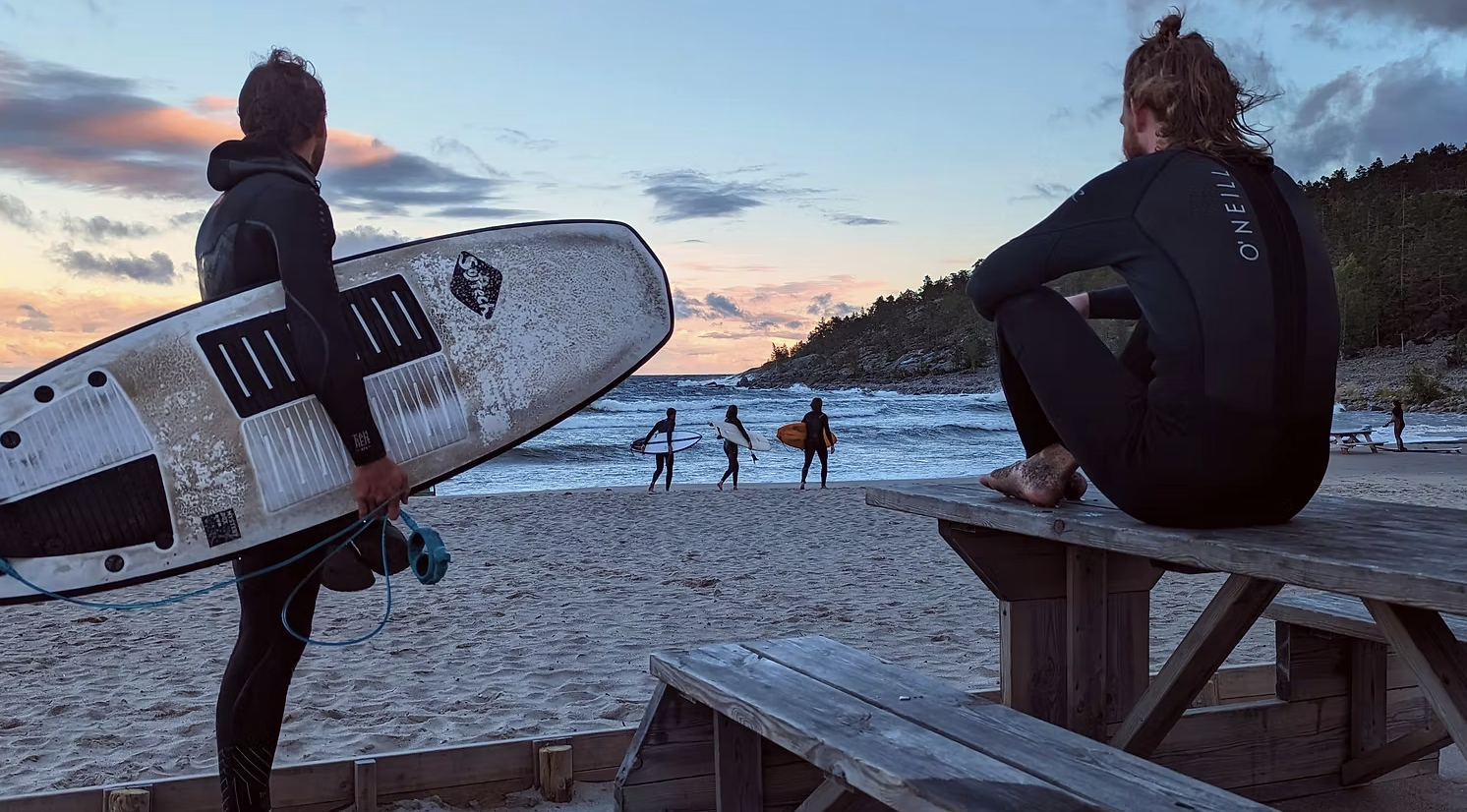
The argument is this: the things that most remote workers say they want from a coliving stay — nature, space, calm, active outdoor life, a real community rather than a transient hotel lobby — are not best found in places saturated with nomads. They are found in places like the Höga Kusten, where you are one of very few people doing this, where the trails are not crowded, where the waves at Smitingen nature reserve will be shared with a local surfer community rather than a Instagram-optimised queue, and where the absence of a well-developed "nomad scene" is itself the feature, not the bug.
"Sarah and Adam are awesome hosts, the house is super cute and well equipped, located in a very quiet and beautiful place. Overdelivered my expectations! Ideal to recharge, slow down and be in nature." — Ana P.
Sarah — Northliving's host — is the most important structural element of this argument. She is not a property manager; she is a remote worker herself (social media manager), a committed outdoor enthusiast, and someone who went through the experience of arriving in Sweden not knowing anyone, falling in love with the High Coast, and building a coliving to share it. The reference, on the activities page, to "Adam even surfs as long as the surfspot is not frozen" is the kind of detail that only appears when the host actually lives the life they're describing. The free pick-up from the train station is the kind of detail that only exists when the host understands what it feels like to arrive somewhere new without a car and not know where you're going.
For a guest, the practical implication is a kind of access that no booking platform can replicate: a host with deep local knowledge, genuine enthusiasm for showing people the region, and the practical infrastructure — equipment, a car for joint excursions, local contacts — to back that enthusiasm up.
The Location: Höga Kusten, the High Coast of Sweden
The Höga Kusten is one of the genuinely underrated natural destinations in Europe — underrated primarily because it sits at the far north of Sweden, well off the standard Scandinavian tourist circuit, and because the countries that get more attention for dramatic coastal landscapes (Norway, Iceland) have more aggressive marketing budgets. The High Coast's case for attention rests on geology and quiet.
In 2000, UNESCO designated the Höga Kusten a World Heritage Site for what it describes as "outstanding opportunities for the understanding of the important processes that formed the glaciated and land uplift areas of the Earth's surface." The world record for post-glacial land uplift — where the Earth's crust, once compressed by Ice Age glaciers, has been rising since the ice retreated — is measured here: 286 metres above sea level at the top of Skuleberget, with the land still rising at approximately 8 millimetres per year. The landscape this process has produced is one of granite cliffs, pine forests, sandy beaches, cobblestone shorelines, and an archipelago of islands accessed by ferry or kayak. The High Coast Trail — 135 kilometres from Hornöberget south of Härnösand to Örnsköldsvik in the north, one of Sweden's 12 designated Signature Trails — runs through all of it.
Härnösand, the nearest town, is described on the Northliving site as "a small but very lively town" and that characterisation is honest. It is not a major urban centre — it is a Swedish coastal town of roughly 18,000 people with an old town, decent beaches, an active leisure infrastructure, and the full range of daily amenities within easy reach. It has a pole studio, a climbing/bouldering gym, a ceramics studio, a tennis club, and a public swimming hall with a spa. Fritidsbanken — Sweden's free equipment lending programme — operates in Härnösand, allowing guests to borrow winter sports gear and other outdoor equipment for up to two weeks at no charge. A public bus runs from Hov to Härnösand several times daily, with a 30-day pass costing approximately €20.
"The next town, Härnösand, and the villages around are very cute and quaint and gave me that special Sweden vibe. Lots of typical wooden houses, like straight out of Bullerbü!" — Louisa K.
The coliving house itself sits in Hov, a village that is quiet by any standard, directly on a large lake, with the Baltic coast a few minutes' drive away. This is not an urban coliving — it is a rural one, intentionally and specifically, and guests for whom city access is a daily requirement should weigh that honestly. A car expands island access dramatically, though the bus covers essential errands and Sarah has historically included guests on car trips into the region.
Destination | Journey |
Härnösand town centre | 15 min by car / bus several times daily |
Smitingen beach / surf spot | ~10 min by car |
Höga Kusten UNESCO area (north) | 20–30 min by car |
Skuleskogen National Park | ~45 min by car |
Härnösand train station (free pickup) | 15 min |
Sundsvall (SJ train hub) | ~45 min by car |
Stockholm (by train) | ~5–6 hours (day train) / ~7 hours (night train) |
Höga Kusten Airport | ~30 min by car |
Stockholm Arlanda is connected directly to Härnösand by SJ trains from the airport terminal (station: Arlanda Central), making the journey manageable without a domestic flight. Night trains run from Stockholm Central, which is itself connected to the European night train network — relevant for guests arriving from Germany, Denmark, or other mainland European destinations.
The Space: A Lakeside House in the Forest
Northliving's house is a single residential property configured for coliving, with the layout logic of a family home rather than a purpose-built facility: generous, lived-in, with enough space to find solitude and enough common area to find company.
The Rooms are all private — no dormitories, no bunk beds. Three bedrooms, each named in Swedish: Solig (sunny), Utsikt (view), and Mysig (cozy). The naming convention is more than decoration; it reflects that these are genuinely different rooms with different characters. At a maximum of three rooms occupied simultaneously, the house can accommodate up to six guests at capacity (for couples who share), though most stays involve a smaller group. Every room has access to the shared bathrooms, the full common area, and all house equipment.
The Coworking and Living Space is shared, designed for both focused work and relaxed community. The house's approach to work infrastructure is honest and practical: the 500 Mbps fibre connection is the headline spec, adequate for video calls, collaborative tools, and anything a standard remote worker would need. The in-house desk setup means guests are not dependent on external coworking spaces for daily productivity.
The Kitchen is fully equipped and communal. Unlike some rural colivings with managed meal programmes, Northliving is self-catering — guests cook their own meals, or head to Härnösand's restaurants and supermarkets. Fresh fruits and vegetables from the garden are available seasonally, which is a quiet but significant detail about the character of the place: someone tends a garden here, and guests are welcome to eat from it.
The Terraces and Garden are two distinct outdoor spaces — one of the practical distinctions that separates a residential Swedish house from a terrace-as-amenity box-ticking exercise. Combined with the garden, they provide outdoor working space, summer evening space, and the kind of casual outdoor gathering area that is genuinely hard to access at any price point in a city coliving.
The Home Gym and Gaming Room are amenities that most colivings at this price point would omit entirely. Their presence signals something about the host's understanding of what a multi-week stay actually requires: not just a desk and a bed, but spaces for energy and decompression that don't require leaving the property.
"The house is very clean and furnished tastefully and cosily. The kitchen is very well equipped! I worked both in my room and in the living room — so I had the perfect mix of a motivating working atmosphere and peace and quiet. There's a bus to Härnösand right across the road during the week, so you can also explore the area without a car." — Sabine E.
The Equipment Library is one of Northliving's strongest practical differentiators. Bikes, surfboards, wetsuits, SUPs, a pole, tennis equipment — all included, all available without booking or additional cost. For a stay in an outdoor-activity region like the Höga Kusten, where gear rental would otherwise add meaningful daily cost, this is a substantial inclusion. The Swedish state also operates Fritidsbanken in Härnösand for winter sports equipment — skis, snowshoes, sleds — available free for up to two weeks.
Laundry (washer and detergent) is included. Bedding and towels are provided. The all-inclusive bill covers all house utilities, removing the negotiation about shared costs that can create friction in informal shared accommodation.
Pets are welcome by request — guests should disclose their animal before confirming a booking. This is a small but genuine point of difference from many urban colivings, where pets are categorically excluded.
The Rooms: Three Rooms, Three Personalities
Northliving offers three private bedrooms, each with access to the shared bathrooms and all common spaces:
Solig (Sunny) — The brightest room in the house, oriented toward natural light.
Utsikt (View) — Named for its outlook; the room with the best exterior perspective.
Mysig (Cozy) — The intimate option; smaller, warmer, the kind of room that feels like a deliberate retreat.
All rooms are private. All guests share bathrooms, the kitchen, coworking space, terraces, and garden. The maximum occupancy is six (two per room for couples), though the coliving's small size means solo guests may frequently find themselves in a house with only two or three other people — an intimacy that is either the feature or the concern, depending on what you're looking for.
Pricing:
€850 / 30 days — 1 coliver per room
€1,300–€1,350 / 30 days — 2 colivers per room (confirm current rate directly)
Minimum stay: 6 nights
The pricing reflects an all-inclusive model: room, all utilities, 500 Mbps internet, free equipment use, laundry, bedding, garden produce, and free train station pickup are all part of the base rate. There is no separate coworking fee, no day-pass for the gym, no equipment hire on top.
Cancellation policy: Full refund up to 30 days before check-in. 50% refund between 14 and 30 days before check-in. Non-refundable within 14 days.
The Community: Small House, Host-Defined
The community at Northliving is shaped primarily by Sarah and secondarily by whoever else happens to be booked that week — which is both the honest description of a small coliving and a useful frame for understanding whether it is the right choice.
Sarah's background is formative: she lived in colivings around Europe as a remote worker herself before building Northliving. This means the house design reflects actual understanding of what a multi-week stay requires (the gym, the equipment, the terraces, the all-inclusive bill), and the community programming reflects what she found valuable in her own coliving experiences rather than what a hospitality manual recommends. The framing on the website — "what I wanna create up here in Sweden" — is a personal project, not a scaled product.
"The host is just lovely, very accommodating and she took me to some gems in the area I probably wouldn't have found myself. She knows about every hiking trail and sight there is, so I was never short of ideas of what to explore." — Louisa K.
"She showed me so many nice places, Christmas markets and some real Swedish lifestyle. I absolutely LOVED staying here." — Andrea G.
"Very nice hosts who love to show you around, they will make sure you are having a great time!" — Mark R.
Weekly community activities are offered without obligation: dinners, movie nights, excursions into the Höga Kusten, ski and surf trips, activities that change with the season. Guests decide what they participate in. This opt-in model is appropriate for a house where guests may have very different working schedules and social energy — it creates the possibility of community without requiring it of people who arrived to work.
The realistic limitation of a three-room coliving is that the social life depends heavily on who is booked simultaneously. In a full house, the mix of people can be extraordinary — the High Coast attracts a specific kind of outdoor-interested, Sweden-curious, off-the-beaten-track remote worker that tends to produce interesting dinner table combinations. In a quieter week, with one or two other guests, the coliving functions more like a host's home where you are a welcomed long-term visitor. Neither of these is wrong, but they are different experiences, and prospective guests who want a guaranteed vibrant social scene should weigh the house size honestly.
What Northliving offers that larger colivings cannot is a depth of local knowledge that scales down as the community scales up. Sarah knows the surfers, the hikers, the town. She knows which trails are accessible on foot from the house and which require a car. She knows what Fritidsbanken has in stock for winter sports. She picks you up from the train station. For a first-time visitor to northern Sweden, this is not a small thing.
"What marked my experience was the atmosphere: Sarah and Adam are kind, stress-free, positive and open-minded people. This energy could be felt in all the other guests as well and it resulted in a really great community to share moments, thoughts and adventures." — Maxime VD
"We did lots of things together — whether it was hiking, playing games, cooking or enjoying the first rays of spring sunshine on the veranda. I felt at home and welcome right from the start." — Sabine E.
"We stayed for two months in the Northliving with Sarah and Adam and we had such a good time — so many adventures." — Hanna W.
What People Say
Northliving Sweden is a small and relatively young coliving, and its body of published third-party guest reviews is limited. What exists comes from the coliving's Instagram presence, travel writers who have covered the Höga Kusten as a destination, and the broader community of remote workers who have documented stays in northern Sweden.
On the Höga Kusten as a remote work and nature destination:
"Places like Höga Kusten exist in other parts of the world… but the difference here is scale and solitude. On the High Coast, you rarely compete for space. The horizon stretches uninterrupted, and nature feels fully in charge." — Shauna Sadowski, substack
"In Höga Kusten, we keep meeting people down by the sea… True, it does rouse a feeling of togetherness, huddled around a campfire, sharing stories and frosty air." — Tamara Thiessen
On the High Coast Trail (directly accessible from a Härnösand base):
"The trail winds its way through nature reserves, a natural World Heritage Site and a national park… 135 kilometres of magnificent views and dramatic landscapes await along the world's highest coastline, divided into 9 stages." — Swedish Tourist Association
On the specific appeal of smaller, host-led colivings versus large properties (applicable to Northliving's model):
"At one point, during an impromptu household dinner and games night, I counted eight nationalities represented at our table; all of us sharing our respective cultures and ideas, and collectively experiencing and reflecting on [the destination] through our unique cultural lenses." — The Professional Hobo
"I wasn't as productive [when I moved to a solo apartment] and I ate more potato chips than I should have... the presence of others at a coliving space gives you that wee bit of extra motivation to get out the door and experience your destination." — The Professional Hobo
Critical notes worth including:
The absence of a substantial body of independent guest reviews for Northliving specifically — as compared to larger, more established colivings with hundreds of coliving.community listings or Trustpilot reviews — is a real limitation for prospective guests who make decisions based on review volume. The coliving is host-credentialled (Sarah's own coliving experience, personal investment in the region) rather than platform-credentialled. For some guests, this is reassuring; for others, it requires a different kind of due diligence — a conversation with Sarah directly, a look at the Instagram, a read of what's been written about the region rather than the house.
The rural location and car-dependence for anything beyond Härnösand town is a genuine logistical variable, particularly for guests without a driving licence or comfort renting in an unfamiliar country.
And Sweden's climate is not for everyone. Even summer in the Höga Kusten — beautiful, long-day, warm — is not a Mediterranean climate. Winter stays, which Northliving explicitly offers and which have their own extraordinary character (snow-covered forests, aurora possibilities, cross-country skiing from the doorstep), require active enjoyment of cold rather than tolerance of it.
The Experiences: UNESCO Wilderness, Surf, Snow, and Stillness
Northliving's activity proposition is built on two elements: what the house provides (equipment, a knowledgeable host, a structured list of activities offered weekly), and what the Höga Kusten itself provides — which is, to put it simply, one of the most comprehensively activity-rich natural environments in northern Europe across all four seasons.
Summer and Autumn (June–October): Hiking the High Coast Trail sections accessible from a Härnösand base (the trail's southern stages begin nearby); wild swimming and beach days at Smitingen nature reserve and the region's sand beaches; sea kayaking in the archipelago; surfing (Baltic waves exist, the local surfer community is small and welcoming, boards are included); SUP paddling on the lake directly from the house; cycling on forest and coastal tracks; island-hopping by passenger ferry to Ulvön, Trysunda, and Grisslan; fishing; and the region's signature experience of sitting in the forest with no one around you and understanding why Swedes structure their entire culture around the right to do exactly that.
Winter (November–March): Cross-country skiing on tracks that begin at the house's lakeside; ski and snowboard slopes at Härnösand's local slope and several others within the region; hiking on winter trails (possible on foot in good conditions; otherwise with snowshoes or hiking skis available via Fritidsbanken); the full stillness of a northern Swedish winter forest after snowfall; and the possibility — not a guarantee, but a real possibility at this latitude — of aurora sightings on clear nights.
"I went in the winter and got to enjoy real cold, lots of snow, was able to go snowboarding too, and I saw amazing northern lights. Overall, 10/10! I'll be back." — Louisa K.
"Those adventures were also fuelled by Sarah's knowledge of the large area of things to do all around. I keep a very fond memory of my trip and all the first experiences I had here — it being my first time in such a cold winter." — Maxime VD
Year-round in Härnösand: The bouldering gym, pole studio, ceramics studio, swimming hall and spa (Härnösand Simhall), tennis club, and access to Sweden's Fritidsbanken equipment lending service. Restaurants and cafés in the town centre (15 minutes by bus or car). Supermarkets for self-catering. The small but characterful old town.
Equipment included at the house: Bikes, surfboards, wetsuits, SUPs, a pole, tennis rackets, and further items depending on season and Sarah's current kit. Fritidsbanken in Härnösand covers winter sports gear (ski equipment, snowshoes) for free, for up to two weeks — an extraordinary public resource that significantly reduces the cost of active winter stays.
The rhythm of a Northliving stay at its best resembles something that most nomad destinations claim to offer but rarely deliver: genuine deep work in the mornings, a trail or beach or snow in the afternoon, a shared dinner in the evening, and the particular contentment of physical tiredness from a day spent outside in a place that earns your attention.
Pros & Cons
Pros
One of the only colivings in a UNESCO World Heritage Site. The Höga Kusten is not an aspirational backdrop — it is the actual environment in which guests live and work. The High Coast Trail, the granite cliffs, the archipelago, the forests, and the beaches are accessible directly from the house or within 15–30 minutes. No other coliving in northern Sweden offers this combination of work infrastructure and natural access.
All-inclusive, no bill surprises. The monthly rate covers everything: room, utilities, fibre internet, equipment use, laundry, bedding, garden produce, and train station pickup. For guests who have navigated the cost complexity of some colivings — where the base rate is the floor, not the ceiling — the transparency here is a genuine comfort.
Exceptional equipment inclusion. Surfboards, SUPs, bikes, wetsuits, hiking gear, and more at no extra cost, alongside the free Fritidsbanken municipal lending service for winter sports equipment. In an active outdoor destination, this inclusion has real financial value over a multi-week stay.
Host with genuine local depth. Sarah lives this life — she surfs, she hikes, she knows the region. The coliving is not managed from a distance; it is run by someone with personal investment in both the place and the guests who come to experience it. For a first-time visitor to the Höga Kusten, this is the difference between being a tourist and being oriented.
Four-season operation. Many nature-focused colivings are summer propositions. Northliving is open year-round, and winter — with cross-country ski tracks from the doorstep, snow-covered forests, and the full character of a northern Swedish season — is not a compromise option. It is one of the property's strongest offerings for the right guest.
Pets on request. Rare in urban colivings; here, negotiable. For remote workers who travel with animals, this is the kind of flexibility that can make or break a stay.
True off-the-beaten-track Sweden. The High Coast sees a fraction of the tourist volume of Stockholm, Gothenburg, or the Swedish Lapland aurora circuit. Guests here are experiencing a part of Sweden that most travellers never reach, in a house run by someone who chose to stay when she could have left.
Cons
A car is highly recommended. The bus from Hov to Härnösand runs several times daily and is adequate for town errands and the train station, but independent exploration of the Höga Kusten — its national parks, archipelago ferry terminals, coastal villages, and trail access points — requires either a car, a bicycle for shorter distances, or reliance on Sarah's willingness to include guests on outings. Guests without a driving licence or comfort renting should plan around this.
Small community by design. Three rooms means a maximum of six guests, and frequently fewer. For remote workers whose primary coliving goal is a rich social ecosystem with diverse international company, Northliving's intimacy is a structural limitation. The community that forms is warm and genuine, but it is a household, not a hub.
Limited independent review volume. Prospective guests who make decisions based on aggregated third-party review data — Trustpilot, coliving.community, Google Reviews — will find that signal thin here. The coliving is credentialled by its host's personal investment and knowledge, not by review volume. Due diligence via direct conversation with Sarah and her Instagram presence is the practical alternative.
Rural Sweden is a specific disposition. Northliving does not suit guests who need urban density — daily coffee shop rotation, restaurant variety, a coworking hub with networking events, the anonymous productivity of city life. The nearest city of any size is Sundsvall, 45 minutes by car. The closest thing to an evening out is Härnösand's modest but genuine town centre, 15 minutes away. This is a considered trade-off, not an oversight.
No included coworking hub. Unlike Madeira Remote, which includes access to an external coworking space with a broader community, Northliving's work infrastructure is in-house: your desk in your room, or the shared living space, or (in summer) the terrace. For guests who work better with the separation of a dedicated external coworking space, this limitation is real.
Sweden's cost of living. Remote workers from lower cost-of-living bases should note that Sweden — while offering excellent value relative to Stockholm in this region — is not a budget destination. The coliving's all-inclusive rate is reasonable for what it provides, but eating out in Härnösand, excursions, and any rental car costs add up at Scandinavian prices.
How Northliving Sweden Compares in the Wider Coliving Market
Factor | Northliving Sweden | Typical Nature Coliving (EU) | Typical Urban Coliving (EU) |
UNESCO World Heritage setting | ✓ Yes — Höga Kusten | Rare | No |
Equipment library (surf, SUP, ski, bikes) | ✓ Extensive, included | Limited | No |
Host depth of local knowledge | ✓ Personal investment | Varies | Rarely applicable |
City access | 15 min to Härnösand | 20–40 min | Walking / in-city |
Car needed | Yes (recommended) | Often yes | No |
Community size | 3 rooms / ~6 max | 5–15 rooms | 10–30+ rooms |
Coworking hub included | In-house only | In-house or nearby | Often included externally |
Pets allowed | On request | Sometimes | Rarely |
All-season operation | ✓ Yes | Sometimes | Yes |
Min stay | 6 nights | 1 week–1 month | 1 week–1 month |
Price point | From ~€850/month | From ~€700–1,200/month | From ~€900–1,800/month |
Meals included | No (self-catering) | Sometimes | Rarely |
Northliving's structural advantage over comparable rural colivings in Europe is the combination of a genuinely exceptional natural environment — not many colivings sit inside a UNESCO site with a 135km signature hiking trail accessible from the neighbourhood — and a host who not only understands that environment but actively lives within it. The small scale is not a concession to limited resources; it is the design.
The Bigger Vision: Remote Work in the Sweden That Most Nomads Never Reach
Sarah's stated reason for building Northliving is personal: she experienced the value of coliving as a remote worker herself, she arrived in Sweden and found herself somewhere extraordinary, and she wanted to create the thing she had wished existed when she got there. This is a founder story without the startup vocabulary, and it reflects something real about how the coliving operates.
The Höga Kusten is not a destination that has been optimised for the international remote worker. There is no Digital Nomad Village infrastructure, no monthly event calendar managed by a non-profit, no coworking hub with a social media strategy. What exists is a UNESCO-listed landscape, a Swedish town with genuine local life and leisure infrastructure, a host who has made it her home, and a house set up to let other people experience it for a week or a month at a time.
For the right guest, this is not a limitation. It is the specific thing they came for.
The broader picture of remote work in Sweden is still developing. Sweden does not yet have a digital nomad visa — EU citizens can stay and work freely, while non-EU citizens are typically limited to 90-day tourist visa stays within the Schengen area. For the majority of Northliving's likely guests (Europeans, particularly those from Germany, the Netherlands, and Scandinavia's neighbouring countries), this presents no practical obstacle. For non-European nomads who want a longer Swedish base, the visa landscape requires planning.
What Sweden offers to those who navigate the logistics is a country with globally-leading internet infrastructure, a work culture built around flexibility and autonomy, extraordinary public access to natural land through the right of allemansrätten (the right to roam), and — in the Höga Kusten specifically — a quality of natural environment that competes with anywhere in Europe for drama, solitude, and reward.
Northliving is a door into that environment. It is a small door. But the view it opens onto is very large.
Frequently Asked Questions
What is included in the Northliving stay? All-inclusive bill covering the private room, all utilities, 500 Mbps fibre internet, free use of all house equipment (bikes, surfboards, SUPs, wetsuits, tennis equipment, and more), laundry and detergent, bedding and towels, fresh garden produce (seasonally), cleaning of common rooms, and free pickup from Härnösand Central or Sundsvall Central train stations.
What is the minimum and maximum stay? Minimum 6 nights. No stated maximum — monthly pricing suggests extended stays are the primary model. Contact Sarah directly for availability and to discuss longer commitments.
What room types are available? Three private bedrooms — Solig (sunny), Utsikt (view), and Mysig (cozy) — all with shared bathrooms. Couples may share a room; confirm pricing (€1,300–€1,350/month for two) directly.
Is the internet reliable for remote work? Yes. 500 Mbps fibre is provided throughout the house. For context, 500 Mbps is more than sufficient for video calls, collaborative tools, large file transfers, and any standard remote working use case.
Do I need a car? A car is strongly recommended for independent exploration of the Höga Kusten. For daily errands, a bus runs from Hov to Härnösand several times daily (30-day pass ~€20). Sarah joins guests on car trips when schedules align. For guests without a car, it is worth discussing logistics with Sarah before booking — rental options are available from Härnösand.
What activities are available? Year-round: hiking, cycling, swimming, and outdoor life. Summer and autumn add surfing, SUP, and kayaking. Winter adds cross-country skiing, snowboarding, and snow hiking. Weekly community activities organised by Sarah include dinners, movie nights, and excursions — participation is always optional. Härnösand's town infrastructure (climbing gym, pole studio, swimming hall, tennis) supplements the outdoor offer.
Are pets allowed? Generally yes, on request. Contact Sarah before booking to discuss your pet.
How do I get there? By train from Stockholm (Arlanda Central or Stockholm Central, via SJ) to Härnösand Central or Sundsvall Central — free pickup from both. By car on the E4 motorway north, a ~5 hour drive from Stockholm. By plane to Höga Kusten Airport (Kramfors), approximately 30 minutes from the house.
How do I book? Via northlivingsweden.com/booking-join-us, or by contacting Sarah directly at northlivingsweden@gmail.com or via Instagram @mynorthliving.
Is Northliving open in winter? Yes, fully. Winter is one of the property's strongest seasons for the right guest: cross-country ski tracks begin at the lake beside the house, local ski slopes are nearby, and the landscape has a quality that Swedish summer simply cannot replicate.
Final Verdict: Is Northliving Sweden Worth It?
For the right kind of guest — someone who came for the nature, wants a host rather than a manager, and values depth of experience over breadth of amenity — yes, clearly.
Northliving Sweden is not primarily a coworking space or a social hub. It is primarily a well-run house in one of the most spectacular natural environments in northern Europe, operated by a host who lives there herself and has filled it with exactly the equipment, knowledge, and warmth that the environment calls for. The fibre internet works. The rooms are private. The equipment library is genuinely impressive. The lake is right there.
What you would choose Northliving for is not the spec sheet. You would choose it because you want to hike a UNESCO trail on a Tuesday afternoon and then be back at your desk by the time your Berlin colleagues start their stand-up. Because you want to surf Baltic waves with a local who will still be in the water when you've had enough. Because you want to ski across a frozen lake in February and understand, finally, why Swedes talk about winter the way they do. Because arriving somewhere remote and genuinely wild, with a host who knows every trail and will pick you up from the station, is the coliving experience that most people are trying to describe when they say they want "something real."
The trade-offs are honest: the community is small, the car matters, the reviews are thin on the ground, and northern Sweden in any season requires a willingness to be somewhere genuinely far from the standard nomad circuit. These are not reasons to avoid Northliving. They are the description of what Northliving is.
"I had an absolutely amazing time in Sweden at Northliving! It was the perfect place for me to relax and reconnect with nature. Overall, 10/10! I'll be back." — Louisa K.
The Höga Kusten was here before Sarah built the coliving, and it will be here after your stay ends. The question is whether you want to be inside it for a week, or just look at photographs.
Book your stay at Northliving Sweden → 🌐 northlivingsweden.com 📍 Hov, near Härnösand, Västernorrland, Sweden 📧 northlivingsweden@gmail.com
Last updated: 2026 | Based on firsthand research, site content from northlivingsweden.com, destination data from hogakusten.com, visitsweden.com, and the Swedish Tourist Association, independent travel writing from tamarathiessen.com and shaunasadowski.substack.com, and the UNESCO High Coast World Heritage Site documentation.