
Pachamama Farm Retreat Coliving Review (2026): The Farm-to-Table Wellness Coliving in Kotor Bay, Montenegro
Honest Pachamama Farm Retreat coliving review (2026). A century-old stone farmhouse above Kotor Bay, Montenegro — one hectare of permaculture land, three farm-to-table meals daily, year-round coliving for digital nomads, remote workers, slow travellers, and families. Yoga, sound healing, communal life, a swimming pool, and some of the most genuinely community-rooted hosting in European coliving. From €672/month (low season). This is what it's actually like.
What Is Pachamama Farm Retreat?
There is a category of coliving that resembles a serviced apartment with a shared kitchen. And then there is Pachamama. The two are not in competition; they are not even in the same genre.
Pachamama Farm Retreat sits above Kotor Bay in Montenegro on a hectare of permaculture land, inside a restored century-old stone farmhouse that was derelict when its founders arrived and has been rebuilt, room by room, with upcycled materials, hand-built furniture, and four years of deliberate effort. The property includes 350-year-old ruins, a traditional Gumno stone circle, an ancient stone mill, an Austro-Hungarian water cistern, a swimming pool, farm animals, a vegetable garden, a yoga hall, hammocks in the trees around the treehouse, and a campfire area. None of this is decorative. All of it is in daily use.
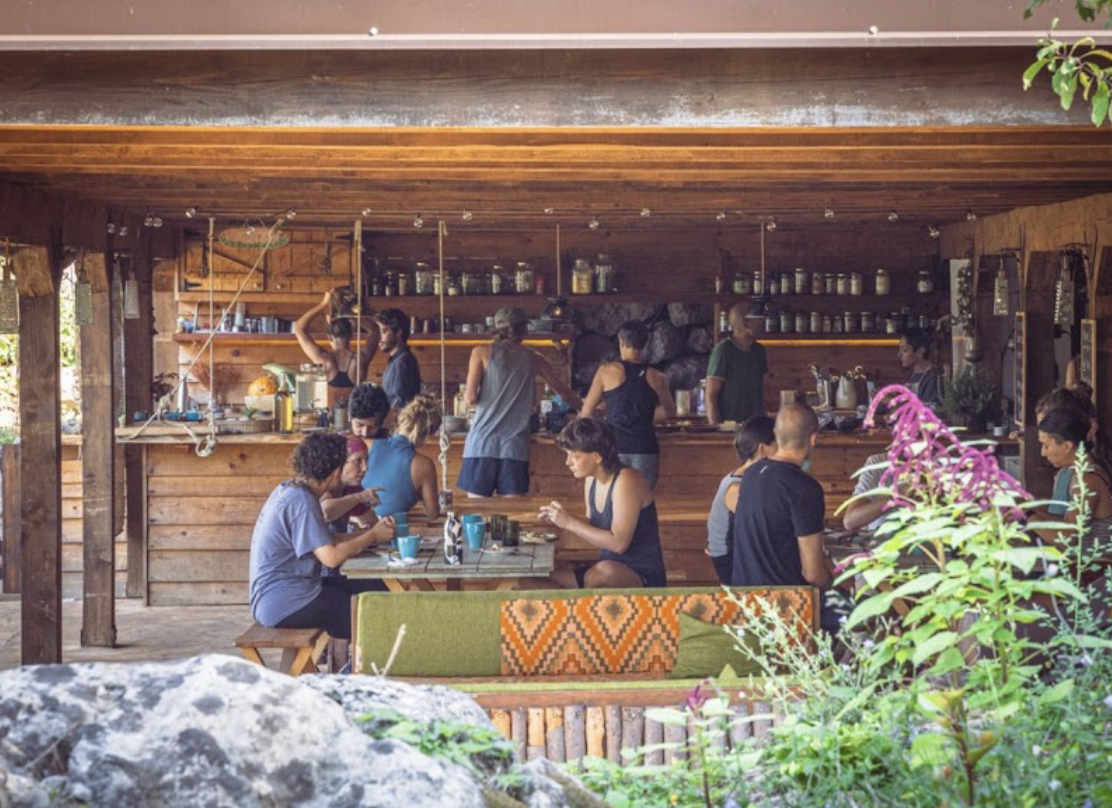
The co-living program — open year-round to digital nomads, remote workers, slow travellers, homeschooling families, and artists — is built on a single premise: that the way you live matters as much as where you live. Three farm-to-table meals are included daily. Each adult contributes around one hour of community life per day, mostly around mealtimes. Yoga, meditation, sound healing, beach hikes, and excursions to Kotor Old Town are woven into the rhythm rather than bolted on as extras — many of them run through Pachamama's own retreat calendar, which co-living guests can join at reduced rates. There is a community car. There are no traffic sounds. The nearest crystal-clear beach is 6 km away.
The founders are Pasha — an Iranian-born entrepreneur who sold a catering business in Tehran, bicycled across the world, and arrived in Montenegro — and Zoe, a Swiss woman who left conventional life to explore something more intentional. Their son Jiji grows up here. Their community includes Shabnam, whose cooking draws more praise in reviews than almost anything else, Shahriar the farmer, Natalia the gong master and sound healer, and Pauliina, a dance artist and yoga teacher. This is not a management team. It is a household.
This review tells you what that actually means in practice — including the things that don't show up on the website, and exactly which room, cabin, or tent to book depending on what you're looking for.
Pachamama Farm Retreat Coliving is best for:
✓ Digital nomads and remote workers seeking slow living with reliable Starlink internet ✓ Slow travellers who want community, nature, and depth rather than a desk and a door ✓ Homeschooling families looking for a supportive, multilingual environment ✓ Artists, writers, and musicians drawn to an informal creative residency setting ✓ People recovering from burnout who need a genuinely nourishing environment ✓ Wellness-oriented residents who want yoga, meditation, and sound healing built into daily life ✓ Couples — all accommodation types support two-person occupancy
Book Pachamama on CoDNX → 📧 behappy@pachamamaretreat.me 📍 Kotor Bay area, Radanovići, Montenegro
Comparing options first? Browse every coliving space in Montenegro and beyond on CoDNX, or start with our Coliving Guide if this is your first long-stay booking.
Why Pachamama Is Different
Most colivings are built around productivity and connection. Pachamama is built around something more fundamental: the idea that daily life itself — how you eat, who you cook with, what you grow, how you rest — is the substance of the experience, not its backdrop.
The founding story is important context. Pasha did not build Pachamama as a business first and a community second. He arrived in Montenegro after years of travelling by bicycle, working on eco-farms and in spiritual centres across the world, having already sold a successful catering business in Iran because the success felt empty. He and Zoe built Pachamama to live in — and then opened it to others, because that is what their values demanded. The co-living program is the extension of a way of life, not a product layered over a property.
This distinction manifests in concrete ways. Meals are not a catering service; they are the daily rhythm of the household, and the food — described in review after review as extraordinary, as the best vegetarian food guests have eaten anywhere — comes substantially from the farm. Eggs from the chickens. Vegetables from Shahriar's garden. Dairy from neighbouring farmers. The cook, Shabnam, brings Iranian and Italian influences into dishes that a Places of Healing write-up described as soulful meals designed to support body and mind. The one-hour daily community contribution expected of each adult — helping in the kitchen, tending shared spaces, supporting the garden — is not a chore list. It is the mechanism by which guests become part of a household rather than merely occupants of rooms.
The wellness programming — yoga, meditation, sound healing, gong baths, cacao ceremonies, ecstatic dance — is available to co-living guests at substantially reduced rates through the property's structured retreat weeks (see the full experience calendar), or absorbed ambiently into the everyday rhythm. The wellness at Pachamama is not primarily delivered through programmes. It is the campfire, the hammock, the morning silence, the meal shared between seven people who arrived as strangers, the hike to a beach that most visitors to Montenegro will never find.
The Location: Kotor Bay and the Balkan Hinterland
Montenegro is among Europe's least visited countries by western nomads, which makes it, paradoxically, one of its most rewarding. The Kotor Bay area — a UNESCO-protected fjord-like inlet ringed by limestone karst mountains, one of the most dramatically beautiful coastal landscapes in the Mediterranean world — is the geographic anchor of Pachamama.
The farm itself sits above the bay in a forested hillside setting near Radanovići, deep enough in the landscape to feel genuinely rural while remaining strikingly close to some of the most significant heritage and coastal destinations in the Adriatic. There is no traffic noise. There is mobile signal, though it can be patchy in parts of the property; the Starlink covers the relevant working areas reliably.
Destination | Journey Time |
Nearest beach | ~20 min by car / 6 km on foot |
Kotor Old Town (UNESCO) | ~15–20 min by car |
Tivat | ~20 min by car |
Budva | ~25–30 min by car |
Tivat Airport | ~12 km / ~15 min by car |
Dubrovnik Airport | ~62 km / ~1 hr by car |
Podgorica Airport | ~84 km / ~1 hr by car |
Main road with bus connections | ~4 km from property |
Getting here without a car is possible but requires planning. The main road with bus connections to Kotor and Tivat is 4 km from the property. Pasha can collect arriving guests from Tivat Airport or arrange a pick-up. A community seven-seater car is available for residents to use upon signing a usage agreement and covering costs. Given that the property is self-contained and three meals are included daily, most residents find that car access is needed primarily for town trips and beach excursions rather than daily logistics — including trips built into the Nature Adventure Holiday retreat week.
Kotor Old Town — a labyrinthine Venetian-era walled city that draws cruise ships from across the Adriatic — is 15–20 minutes by car and worth more than one visit. Budva, Montenegro's most developed beach resort, is 30 minutes south. The Costa Brava-grade beaches of the Bay, accessible via the community car or a 6 km hike, are the coastline that most visitors to Montenegro's tourist circuit will never see.
Montenegro itself is an underrated destination for extended stays. It sits outside the EU Schengen Zone, which makes it attractive for digital nomads managing 90-day visa limitations. The cost of living is low relative to Western Europe. The landscape — where Balkan mountains meet Adriatic coast within a country smaller than Wales — is genuinely spectacular. And the tourism infrastructure remains light enough that off-the-beaten-path feels real rather than performative.
The Space: A Century-Old Stone Farmhouse Rebuilt With Intention
The physical environment at Pachamama is unlike any other coliving in this guide. This is not a villa adapted for shared living, or a purpose-built nomad campus, or a renovated urban apartment block. It is a farmhouse, a farm, and an ancient landscape — and every element of it carries history.
The Stone House is the centre of the property: a three-bedroom structure with its own ensuite facilities, restored from ruin over four years using upcycled materials and hand-built furniture. Its thick walls keep it cool in summer and retain warmth in winter (it has a heating and cooling system). The rooms have character that no modern construction can manufacture: uneven stone, deep-set windows, a quality of age that is immediately felt.
The Yoga Hall is a multi-purpose space equipped with mats, props, and an aerial yoga hammock, used for yoga and meditation sessions, dance, sound healing, ecstatic dance — the kind of programming built into weeks like Vibration of Peace — gatherings, and movie nights with a large screen and projector. This is the programmatic heart of the wellness offering.
The Swimming Pool provides a practical and social outdoor amenity during the warm months. The campfire area anchors evening social life — board games, music, conversation, and the kind of storytelling that only happens around fire. Hammocks are distributed across the garden, within easy reach of the Treehouse.
The permaculture garden is a working farm, not an ornament. Shahriar tends it with genuine expertise and passion — having left a career as a documentary maker specifically to return to the land. The garden contributes to the meals residents eat daily; what it produces is not symbolic but real.
Ancient site features — the Gumno (a traditional Balkan stone threshing circle), the old stone mill, the Austro-Hungarian water cistern, the 350-year-old ruins scattered across the property — are not roped off. They are part of the landscape guests move through each day.
Musical instruments, board games, and a chess set are available throughout the shared spaces. A ping-pong table and trampoline provide more active downtime. A tennis court is within walking distance, and the team organises regular trips to town for padel. A sauna is noted as coming soon.
Practical working infrastructure is present in every room: a desk, comfortable chair, and high-speed Starlink Wi-Fi. A shared working space is available for advance booking. The Wi-Fi covers the full property.
The property accommodates campers and campervans in a dedicated campground area with 220V power access — an unusual and genuinely practical feature that opens Pachamama to a segment of the nomad community that most colivings cannot serve.
The Accommodation: Five Types Across Three Settings
Pachamama offers a range of accommodation configurations that reflects its layered identity: from stone house rooms with private bathrooms to glamping tents and campground pitches. All stays include three meals daily. Full details, availability, and current pricing for every room type below are on the main Pachamama listing.
Stone House — Lavender — Shared Loft Room, Ensuite 35 m² lower level with three bunk beds and a chilling area, plus a 20 m² loft with two twin beds. Mountain view. Sleeps up to 8 as shared. Low season from €36/night | €784/month. High season from €76/night | €1,686/month. Live pricing and availability for this room are on the main listing page above — this room does not yet have its own dedicated listing.
Stone House — Pomegranate — Private or Shared Loft Room, Ensuite 40 m² room plus 20 m² loft, configurable as private or shared. Two beds below, two in the loft. Mountain view. Sleeps up to 4. Low season from €62/night | €1,372/month. High season from €133/night | €2,968/month.
Stone House — Ivy — Private Room, Ensuite 35 m², double bed and convertible sofa bed. Garden view. Sleeps up to 3. Low season from €53/night | €1,176/month. High season from €112/night | €2,492/month.
Wooden Cabins — Oak & Jasmin Two 9 m² cabins, each sleeping 2 (double or twin configuration). Oak Cabin runs on solar power; Jasmin Cabin on city grid. Both use the shared glamping bathroom. Low season from €44/night (private) | €980/month. High season from €90/night | €1,988/month.
Glamping Bell Tents Two bell tents (19 m² and 7 m²), sleeping 2 each. Shared glamping bathroom. Available June 1 through October 1. No heating system. No live listing yet — contact Pachamama directly at behappy@pachamamaretreat.me to book this room type.
Campground Pitch your own tent or park a campervan. 220V power access. Shared glamping bathroom. Up to 10 guests. Low season from €30/night | €672/month. High season from €40/night | €896/month.
Treehouse A 25 m² room with balcony, sleeping 2. Solar power. Shared glamping bathroom. No heating system. Available in warmer months.
Additional adults in any room: from €30/night (low season) | €40/night (high season). Children aged 7–14: €18–22/night. Children aged 3–6: €9–13/night.
Long-stay discounts apply: 20% off for stays over one month; 30% off for over three months; 40% for six months; 50% for a full year. All long-term stays begin with a trial period of up to three months. CoDNX also runs its own team and group discounts on top — worth checking if you're coming with a partner, family, or a small group of friends.
The minimum stay for the co-living program is two weeks — allowing time to settle into the rhythm of the place properly. This is shorter than many colivings and reflects Pachamama's accessibility to shorter-term slow travellers as well as committed long-stay residents.
See all rooms & current prices on CoDNX →
The Community: Farm Life, Shared Meals, and Slow Living
The community at Pachamama is not curated through a screening process in the way that some entrepreneurial colivings are. It assembles itself through self-selection: the people who come here are those who found the property, read what it promises, and chose it specifically. That self-selection produces a remarkably consistent community profile — internationally diverse, wellness-oriented, curious, looking for depth rather than pace — without anyone having to enforce it.
The daily structure is the community architecture. Three meals together, daily, is more connective than any organised event. Sitting down at the same table for breakfast, for lunch, and again for dinner — with food that was partly grown on the land you are walking through, prepared by someone who cooks from genuine care — changes the texture of co-existence in ways that are hard to explain to someone who has not experienced it.
The one-hour daily contribution expectation deepens this further. Helping in the kitchen, setting the table, cleaning up after meals, occasionally supporting the garden or shared spaces — these activities create the feeling, described again and again in reviews, that guests are not visiting Pachamama but living in it. One reviewer who stayed for four weeks wrote that Pasha, Zoe, and the community welcomed them warmly from the moment they arrived, and that they felt part of the family for the whole stay.
The founders are the gravitational centre of the community. Pasha's story — from Iran to a catering business to a bicycle journey across the world to a stone farmhouse in Montenegro — gives him a warmth and openness that reviewers mention by name, consistently and across years of reviews. Zoe brings AcroYoga, massage, music, and sewing. Shahriar brings the land. Shabnam brings the food. Natalia brings sound healing. Pauliina brings dance and yoga. This is a community of people who each brought something real and placed it in service of the space.
Yoga and meditation are available to co-living guests through the on-site program — weekly yoga sessions included in a €95/month option, with individual class booking also available. Co-living guests can join the 7-day retreat programs at a significantly reduced rate of €195, including weeks like Motion & Ocean and Art & Play. Residents who want to deepen their stay can move fluidly between the co-living and retreat modes — see the full experience calendar on CoDNX for current dates.
Evenings are typically quiet and self-organising: campfire, board games, music, a film in the yoga hall, or simply sitting in the dark with Kotor Bay below and the mountains above.
What People Say
Reviews for Pachamama Farm Retreat are among the most consistently emotional in the European coliving space — not because they use superlatives, but because they use specifics.
On the food: Reviewers across BookYogaRetreats and Wanderlog consistently single out the food as the best they've eaten during any retreat stay, describing it as healthy, delicious, and unlike anything they'd experienced elsewhere. Shabnam, the resident chef, is described by the Pachamama team itself as the nurturing heart of the community — someone who feeds guests' bodies with fusion dishes blending oriental spices and Italian culinary technique, and whose cooking guests rave about more than any other single feature of their stay.
On the community and hosts: Guests repeatedly describe being treated like family from the moment they arrive — by Pasha, his family, staff, and volunteers alike — with retreat guests, staff, and volunteers all blending into one social group within days. TripAdvisor reviewers point specifically to the atmosphere as the thing that sets Pachamama apart from anywhere else in the region, describing the warmth and sense of shared family among everyone on site, including former volunteers.
On the sense of place: Multiple TripAdvisor and BookRetreats reviewers describe the property as feeling like the middle of nowhere despite being only 20 minutes from the sea — no traffic noise, patchy signal, a genuine retreat from everyday life. One reviewer who stayed four weeks called it a wonderful, peaceful place where the people and the community they'd built were what made it truly special.
On the setting and activities: Reviewers on camping.info highlight the proximity to secret beaches recommended by staff, plus easy access to Kotor, Tivat, and Budva, describing the place as somewhere they experienced some of the most beautiful days of their travels and left wanting to return.
Critical notes worth including: A small number of reviews raise practical considerations that are worth knowing. Summer heat in Montenegro can be intense, and the wooden cabins and tents operate without air conditioning or heating systems — a real factor for guests arriving in July or August. Some reviews mention mosquitoes during high summer as a genuine nuisance in outdoor sleeping areas, particularly the tents and treehouse. One reviewer noted that the 4 km distance to the main bus road makes a car strongly advisable; hitchhiking is possible but not reliable with luggage. These notes are isolated in context and do not reflect the majority experience, but they matter for anyone planning specifically around the warmer outdoor accommodation options.
The Wellness & Retreat Dimension: What Co-Livers Can Access
Pachamama is not exclusively a coliving — it is a full retreat centre that opens its co-living program year-round alongside its structured retreat offerings. This dual identity creates something unusual: long-term residents can access a level of wellness programming that standalone colivings rarely offer.
For co-living guests, the available options include:
Monthly yoga — €95/month, minimum three sessions per week. All yoga classes, workshops, and guided excursions are also individually bookable.
7-day retreat access — €195 for the full retreat program during any active retreat week. This covers all yoga sessions, workshops, beach hikes, and other programmatic activities during that period.
The 2026 retreat calendar spans multiple formats, each bookable directly through CoDNX:
— hiking, kayaking, SUP boarding, canyoning, and a Kotor Bay boat tour.
— yoga, SUP yoga, and hidden beach hikes.
— yoga, cacao ceremony, gong bath, and ecstatic dance.
— a dance-focused week.
— family- and couple-friendly, built around creative workshops.
— a women-only week of yoga, connection, and community.
The inaugural Pachamama Play Festival runs June 21 to July 4, 2026.
Co-living residents who time their stay to overlap with a retreat week get access to facilitated programming — yoga teachers, sound healers, workshop leaders, excursion guides — at a fraction of the standalone retreat cost. This is a meaningful practical advantage that is easy to overlook when reading the co-living page in isolation. Browse the full, current retreat calendar — at Pachamama and elsewhere — on CoDNX Experiences, or read the Experience Guide if this is your first retreat booking.
Pros & Cons
Pros
The most genuinely farm-to-table coliving in this guide. Meals are not a catering arrangement; they are the expression of a working permaculture farm and a chef who has been cooking with love for years. The food at Pachamama is its most consistently and enthusiastically reviewed feature — ahead of the location, ahead of the community, ahead of the activities. That is remarkable, and accurate.
Three meals per day are included. This is unusual in coliving and transforms the economics and the daily experience entirely. The financial equivalent of daily full-board elsewhere is substantial; at Pachamama it is built into the base rate.
A physical environment with no equivalent in European coliving. Century-old stone, ancient ruins, a working farm, Kotor Bay below, mountains above, campfire circle, hammocks, a Gumno stone circle used for ceremonies. This is not a designed environment — it is an evolved one, and the difference is immediately perceptible.
The founders are genuinely exceptional hosts. The consistency with which Pasha and Zoe appear in reviews — by name, with warmth, over years — is the most reliable signal in the entire review corpus. Great hosting cannot be faked across hundreds of interactions over half a decade.
Year-round coliving with flexible minimum stay. Two-week minimum is shorter than most equivalent rural colivings and makes Pachamama accessible to slow travellers as well as committed long-stay residents. Long-stay discounts (up to 50% for a full year) make it viable as a genuine base.
Family-friendly and child-inclusive. Explicit children's pricing, homeschooling support, and a rural environment suited to young children make Pachamama one of the very few colivings in this space that actively welcomes families as a primary rather than incidental audience.
Significant wellness programming at a co-living price. Access to yoga, sound healing, retreat week programming, beach hikes, and facilitated activities at substantially reduced rates is a structural advantage over colivings that offer generic events.
Outside the Schengen Zone. Montenegro's status outside the EU Schengen area means extended stays don't erode the 90-day allowance — a meaningful practical benefit for European-based digital nomads.
Cons
No car means genuine friction. The main bus connection is 4 km away. Without a personal vehicle or reliable access to the community car, independent city access requires planning and patience.
Summer outdoor accommodation has no cooling. The wooden cabins, tents, and treehouse have no air conditioning or heating systems. Montenegro summers are hot. For guests arriving between June and August specifically into these accommodation types, heat management is a real and unresolved consideration.
Mosquitoes in summer. Multiple reviewers mention mosquitoes in outdoor sleeping areas during high season. Worth factoring into accommodation choice — the Stone House rooms are better insulated against this than the tents or treehouse.
Not a productivity-first environment. Pachamama does not present itself as a coworking hub, and it is not one. The working infrastructure is adequate — Starlink, a desk in every room, a shared working space — but the culture of the place is oriented toward slowing down, not speeding up. For remote workers who need high-intensity focus and zero distraction, the community life rhythm may feel like friction.
Individual cooking is not possible. One shared kitchen serves the whole community, and meals are communal affairs. Residents with strict or complex dietary requirements should discuss this directly before booking.
The lifestyle expectations are genuine. One hour of community contribution daily, communal meals, no private cooking — these are not trivial commitments for people accustomed to autonomous living. They are the architecture of the Pachamama model, and they work for the people they are designed for. But they require honest self-assessment before booking.
Substance-free culture (mostly). Pachamama actively creates a calm, mindful atmosphere oriented away from regular drinking, smoking, and substance use. Guests are asked to smoke outdoors and to drink privately or on special occasions. This is clearly stated and honestly operated — but it is not compatible with residents who organise social life around those activities.
Weighed the trade-offs and ready to see dates? Check availability on CoDNX →
How Pachamama Compares in the Montenegrin and Wider Coliving Market
Factor | Pachamama | Playworking (Montenegro) | Kotor Nest (Montenegro) | Rural Coliving (Europe avg.) |
Setting | Eco-farm, century stone house | Coastal village, Lustica | Kotor Old Town, UNESCO | Varies |
Meals included | 3 daily, farm-to-table | No | No | Rarely |
Wellness programme | Yoga, sound healing, retreats | Activities | None | Varies |
Family-friendly | Yes, children pricing | Limited | No | Rarely |
Schengen-free | Yes (Montenegro) | Yes | Yes | Rarely |
Car dependency | High | Moderate | Low (central) | High |
Community contribution | 1hr/day expected | No | No | Rarely |
Minimum stay | 2 weeks | 1 week | Varies | 2–4 weeks |
Long-stay discount | Up to 50% | No | Varies | Rarely |
Entry price (low season) | From €672/month | From ~€800/month | From ~€900/month | From €600/month |
Pachamama is not competing with urban colivings or productivity-first nomad hubs. It occupies a category of its own: the farm-retreat coliving, where the accommodation, the food, the wellness programming, the community life, and the landscape are a single integrated proposition. If you're weighing it against other options, the full set of Montenegro coliving listings on CoDNX is the fastest way to compare — the closest true comparisons are other farm-stay and retreat-coliving hybrids across Europe, and in that comparison, Pachamama's combination of location, food quality, host character, and price point is genuinely difficult to match.
Frequently Asked Questions
What is the minimum stay for the co-living program? Two weeks. This is the minimum required to settle into the rhythm of the place properly. Long-stay discounts begin after one month (20% off) and increase significantly for stays of three months, six months, and one year.
What is included in the co-living rate? Three homemade meals per day (breakfast, lunch, and dinner), prepared by the community kitchen using farm and locally sourced ingredients. Full access to all shared spaces: yoga hall, swimming pool, campfire area, garden, hammocks, board games, musical instruments. Workspace in your room with Starlink Wi-Fi. Access to the shared working space (advance booking required). Use of the community car upon agreement and cost coverage.
Are yoga and retreats included? Not automatically, but at strongly reduced rates. Monthly yoga is available for €95/month (minimum three sessions per week). Individual classes and excursions are bookable separately. Co-living guests can join 7-day retreat programs for €195 (vs. full retreat pricing) — see current dates on CoDNX Experiences.
Is the coliving family-friendly? Yes. Pachamama is one of the few European colivings that actively welcomes homeschooling families and provides specific children's pricing. The rural environment — animals, a garden, open space, a pool — is well suited to children.
Can I bring a pet? Contact Pachamama directly to discuss. The farm has its own animals and community cats; pet compatibility depends on the specific situation.
How do I get there? Tivat Airport is 12 km away (approximately 15 minutes by car) and is the most convenient arrival point. Dubrovnik Airport (Croatia) is 62 km and a frequent choice for budget airline arrivals. Pasha can arrange collection from Tivat Airport or the nearest bus stop. Driving is the most practical option for extended stays.
Is there a community car? Yes. A seven-seater community car is available for residents upon signing a usage agreement and covering related costs. It is used for grocery trips, beach excursions, and town visits.
What is the lifestyle like regarding smoking, drinking, and substances? Pachamama maintains a predominantly substance-free, mindful environment. Smoking is permitted outdoors. Alcohol is welcome privately or on special communal occasions. Guests are asked to align with this culture or to discuss it openly before arriving.
How do I book? Directly through the CoDNX listing, by email at behappy@pachamamaretreat.me, or via the full Coliving Guide if you want a walkthrough of the process first.
Final Verdict: Is Pachamama Farm Retreat Worth It?
For the right profile of resident — emphatically yes.
Pachamama is one of the most singular colivings in Europe, not because it is the most luxurious or the best-connected or the most design-forward, but because it is the most genuinely itself. Pasha and Zoe built something here from ruin — literally, from stone ruins — and the authenticity of that origin runs through every element of the experience: the food, the community expectation, the presence of the farm, the ancient landscape, the campfire, the way guests describe feeling at home within days of arriving.
The food alone would justify a stay. The community the founders have built around the table, and around the yoga hall, and around the campfire, makes the food the beginning of the experience rather than its peak.
The trade-offs are real: car dependency, summer heat in outdoor accommodation, the commitment to communal life, the distance from urban immediacy. These are not oversights or failures. They are the conditions of the model — and the model works, for the people it was built for.
For a remote worker who needs to slow down more than they need to speed up. For a family seeking an alternative educational environment with international peers. For an artist who needs space, silence, and creative peers rather than a structured programme. For a wellness-oriented nomad who wants yoga, sound healing, and a swimming pool in a landscape of mountains and Adriatic light — and who wants all of this at a price that reflects a country still far outside the European mainstream.
There is something about eating a meal at Pachamama that was grown on the land you can see from your table, prepared by someone who has been cooking in this kitchen for years, shared with seven people you met three days ago who already feel like neighbours — while a goat moves across the garden and the Kotor Bay catches the light through the trees — that no serviced coliving apartment in Lisbon or Bali or Medellin can replicate.
Pachamama built that moment into a daily rhythm. That is worth the journey to Montenegro.
Book Pachamama on CoDNX → 📧 behappy@pachamamaretreat.me 📍 Kotor Bay area, Radanovići, Montenegro
Similar farm & retreat colivings to consider
If Pachamama's rhythm appeals to you but you're still comparing, these are the closest matches in style elsewhere on CoDNX:
Other rural and farm-stay colivings across the Balkans and Mediterranean
Retreat-hybrid colivings with included wellness programming
Family-friendly colivings with homeschooling support
Browse similar colivings on CoDNX →
Still exploring? See every coliving space in Montenegro, browse upcoming retreats and experiences across the platform, or check current team and long-stay discounts before you book.
Run a coliving or retreat yourself? List your property on CoDNX and reach this same audience of digital nomads, families, and wellness travellers.
Last updated: 2026 | Based on firsthand research, site content from pachamamaretreat.me, verified guest reviews from TripAdvisor, BookRetreats, BookYogaRetreats, Wanderlog, camping.info, Places of Healing, and independent Montenegro travel and digital nomad guides.