
Sustainable Bolivia Review (2026): Volunteer in the Amazon
Since 2007, Sustainable Bolivia has protected 20,000+ hectares of Amazonian rainforest alongside the communities that depend on it. Here's the honest picture of what volunteering there actually looks like.
What Is Sustainable Bolivia?
Sustainable Bolivia (SB) is a 501(c)(3) international non-profit founded in 2007, based in Riberalta in the heart of the Bolivian Amazon. Its work sits at the intersection of rainforest conservation, community development, and environmental education — and unlike many NGOs operating in the Amazon, it has delivered a measurable landmark: helping secure formal protection for more than 20,000 hectares of rainforest and river ecosystem through the establishment of the Aquicuana Reserve in 2016.
SB operates primarily inside and around the Aquicuana Reserve, partnering with two rural communities — San José and Warnes — on ecotourism development, biodiversity research, conservation management, and education programmes. It also supports local organisations in the nearby city of Riberalta through volunteer placements and micro-grant funding.
The volunteer programme is the main access point for international participants. SB accepts volunteers year-round across six distinct programmes — from biological research to education, art residency, community support, ecotourism development, and more. There are no placement fees in the traditional sense: SB asks volunteers to contribute to the cost of their accommodation and food rather than charging a programme fee.
This review covers what volunteering with Sustainable Bolivia actually looks like in practice — the daily reality, the logistics, the costs, and who this experience genuinely suits.
Sustainable Bolivia is best for:
✓ Researchers, biologists, and ecologists wanting Amazon field access and a base station
✓ Educators and teachers willing to work with children in rural Amazonian communities
✓ Artists, photographers, filmmakers, and writers seeking deep jungle immersion
✓ Anyone with specific skills to offer — mycology, permaculture, grant writing, web development, cooking
✓ People drawn to genuine conservation work in one of the world's most biodiverse places, not curated eco-tourism
Connect with Sustainable Bolivia on CoDNX →
Who Founded It — and Why It Matters
Sustainable Bolivia was founded by Erik Taylor, an American conservationist and anthropologist who has spent nearly two decades building a conservation ecosystem in the Bolivian Amazon that most people would consider structurally impossible: a formally protected 20,000-hectare reserve, governed in genuine partnership with the municipalities and communities that live inside it, funded largely through a sister plant-medicine retreat rather than government grants or international aid.
Erik and his partner Sasha built Pisatahua — an ayahuasca and plant-medicine retreat on the reserve — simultaneously with Sustainable Bolivia, recognising early that conservation without a sustainable funding model is fragile. The retreat's proceeds directly subsidise SB's community development work, environmental education, and volunteer infrastructure. This financial architecture is unusual, honest, and worth understanding: Sustainable Bolivia is a non-profit with limited public or private funding, and it says so plainly. Its capacity to keep growing depends on Pisatahua's continued operation, donations, and the contribution volunteers make during their stays.
What this means in practice: you are not arriving into a polished international NGO with a large staff and abundant resources. You are arriving into something more real — a lean, founder-driven organisation that has genuinely changed the land and lives around it, and that needs people with skills and commitment, not just good intentions.
The Aquicuana Reserve: The Heart of Everything
What It Is
The Aquicuana Reserve — formally the Área Protegida y Reserva Natural Aquicuana — is a protected area of more than 20,000 hectares (approximately 49,000 acres) of rainforest and river ecosystem located about 20 kilometres from Riberalta in Bolivia's Beni Department. Its name comes from the Tacana native language and means land of the giant trees — a description that holds up.
The reserve was formally established in 2016 after years of collaborative work between Sustainable Bolivia, Pisatahua, the Riberalta Municipality, and the communities of San José and Warnes. It is now protected from agricultural expansion, ranching, logging, mining, and unregulated resource extraction — threats that have cost Bolivia an area the size of Rhode Island in forest cover in just the decade between 2006 and 2016.
Inside the reserve: Lake San José, old-growth rainforest with documented giant mapajo and oje trees, natural water springs, and a biodiversity profile that research is still in the process of fully documenting. Since 2018, SB's biodiversity surveys have identified over 300 bird species. The reserve is one of the only known habitats for the Masked Antpitta (Hylopezus auricularis), a vulnerable and rare endemic species found only in the Riberalta region. Camera traps deployed by visiting researchers have also recorded evidence of jaguars — increasingly rare across the Amazon basin.
Why the Threat Context Matters
Riberalta is the world's capital of the Brazil nut trade — processing roughly 64% of the world's supply — and a growing city of 150,000 people. The local birth rate, improved road access, and expanding agricultural economy create consistent pressure on surrounding forest. The Aquicuana Reserve exists in direct tension with these forces. Its protection is not an administrative given — it requires ongoing monitoring, enforcement, and economic alternatives for local communities. Every SB volunteer and every Pisatahua guest contributes, directly or indirectly, to making that protection viable.
The 2018 Conservation Milestone
In 2018, the community of Warnes began operating a toll checkpoint at the reserve entrance — a fee of 2 Bs (~$0.30) — giving the community direct capacity to monitor activity within the reserve and prohibit illegal fishing and hunting. This is what genuine community-led conservation looks like in practice: not a policy document, but a community with actual physical control over who enters their land.
Where You'll Live: The Reserve & Riberalta
On the Reserve
Sustainable Bolivia volunteers live in shared cabins at the Aquicuana Reserve, using infrastructure shared with the Pisatahua retreat. The facilities were constructed using sustainably harvested wood, bamboo, and palm leaves, designed in accordance with traditional construction techniques and adapted for comfort. The organisation uses renewable energy resources, treats grey water, and brings all waste off-site to Riberalta for disposal.
What volunteers have access to on the reserve:
Shared cabins overlooking Aquicuana Lake
Shared bathrooms and kitchen (3-burner stove, small fridge, fully stocked)
Research station with high-speed Starlink internet (available in the office space; not widespread across the site)
Yoga space (note: unavailable for approximately 10 days per month when in use for Pisatahua retreat ceremonies)
Access to SB's boat for lake research
The reserve's trail network, including 4km of maintained hiking trail with 70+ giant trees, benches, and signage
Meals: When more than three volunteers are present, SB's cooks prepare two meals per day, five days a week. Weekends and breakfasts are self-catered from the fully stocked communal kitchen. Grocery lists are made communally; groceries are transported from Riberalta.
What to know honestly: The reserve is 20 km from Riberalta. In the rainy season, the property has significant mud and large puddles — physical accessibility is limited during this time. There is no reliable cell service on the reserve; Starlink internet is available in the office. Mosquitoes are present year-round; antimalarials are a personal decision but should be discussed with a doctor before arrival.
In Riberalta
Volunteers also have access to a weekend crash-pad apartment in Riberalta for visits, shopping, and rest. SB can also arrange placements with host families in Riberalta for volunteers who prefer a city-based, more culturally immersive experience — though this option requires a one-month minimum commitment and basic Spanish.
What Riberalta has: Fresh markets and a basic supermarket; mosquito spray, rubber boots, pharmaceuticals, and personal hygiene supplies available in town. Cell service exists in the city but can be unreliable.
What Riberalta doesn't have: It is not a convenient base for exploring the rest of Bolivia. The main tourist sites require expensive or infrequent flights. If seeing more of Bolivia is a priority, SB recommends spending additional weeks based in La Paz or Santa Cruz before or after your volunteer placement.
Volunteer Programs: What You'll Actually Do
Sustainable Bolivia runs six distinct volunteer and internship tracks. Placement is determined by applicant interest, time commitment, language ability, and previous experience. All placements are arranged directly through CoDNX or with SB apply by emailing info@sustainablebolivia.org with your CV, a brief statement of interest, and the programme(s) you're considering.
1. Independent Research
The most specialised programme. SB's research station at the reserve provides a home base and access point for independent researchers studying the Amazon ecosystem. SB provides background information, local guides and contacts, basic research materials (camera traps, bug sheets), and help designing a project outline. Researchers are expected to collect meaningful data independently. SB facilitates connections with local researchers and the affiliated local university (UAB-JB).
Active research needs include: Biodiversity documentation (birds, mammals, fungi, plants), water quality monitoring, and medicinal plant mapping. A current mycology programme is seeking an experienced mushroom cultivator to help develop a sustainable production system for local and tourist consumption, and to document wild fungi in the reserve for an in-progress eBook.
Spanish requirement: Beneficial for working with local guides, not strictly required. Minimum commitment: Varies by project.
2. Education and Youth Development
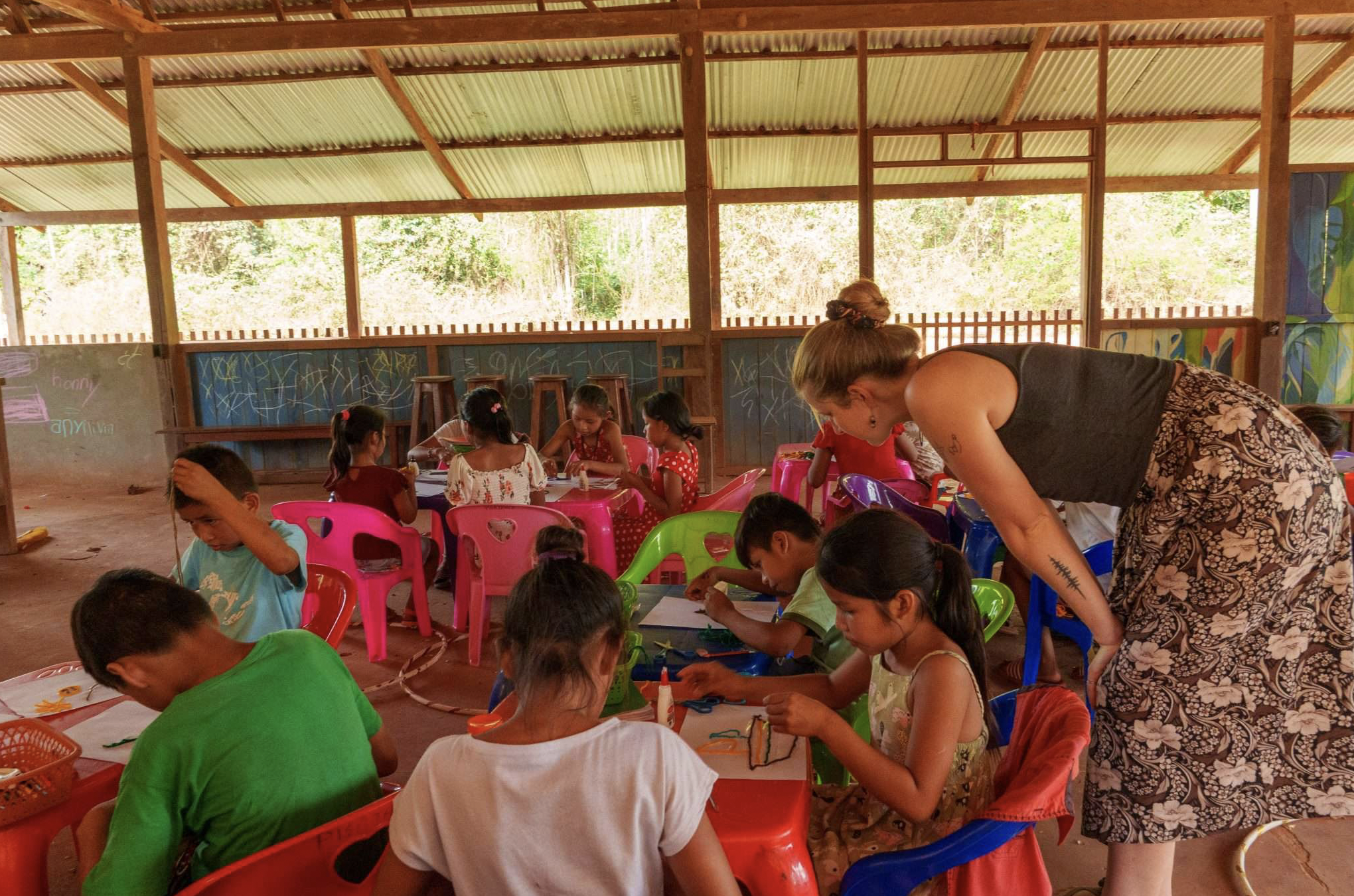
Volunteers assist with SB's afterschool programme at Warnes School, located at the reserve entrance. Classes run 2:30–5:00 pm on weekdays. The primary focus is English teaching, but volunteers with expertise in music, arts and crafts, sports, science, or health are actively welcomed. Morning time can be used for lesson preparation or contribution to other projects.
SB also coordinates placements with orphanages and daycare centres in Riberalta for volunteers who prefer a city-based education role. This option requires one month minimum and basic Spanish.
The Guardians of the Amazon environmental club — active since 2018 — engages 70 children from Warnes School in practical environmental action: cleaning campaigns, ecological awareness, and community stewardship. Volunteers with environmental education backgrounds can contribute directly to this programme.
Spanish requirement: Helpful for city placements; not required for reserve-based work. Minimum commitment: 1 month preferred.
3. Ecotourism and Conservation
Volunteers support SB's ongoing effort to build community-led ecotourism in Warnes and San José. This includes promoting the ecotourism initiative internationally and locally, working with tourism sector actors and platforms, helping maintain hiking trails, supporting guide training, and contributing to the reserve's conservation and resource management work.
This programme is particularly suited to volunteers with backgrounds in tourism, marketing, sustainable development, or conservation management.
Spanish requirement: Beneficial for community liaison work. Minimum commitment: 1 month preferred.
4. Onsite Community Support
For volunteers who want to contribute practically to life at the reserve regardless of specific professional background. Tasks include gardening, construction, cooking, yoga or meditation teaching, and any skills that benefit the on-site community. SB is developing a permaculture garden and welcomes volunteers with relevant expertise. A chef or nutritionist volunteer is an active current need — preparing healthy meals for volunteers and Pisatahua retreat participants.
Spanish requirement: Not required. Minimum commitment: Flexible; can be negotiated.
5. Art Residency
SB hosts visiting artists across all disciplines — visual art, music, creative writing, photography, videography, and film — on the reserve. Artists use the jungle, the lake, the communities, and the broader Riberalta environment as source material. SB does not require artists to donate their work, though contributions to the organisation's promotional materials are welcomed.
Artists work independently; a self-directed disposition is essential. SB is actively seeking videographers for content creation and marketing materials.
Spanish requirement: Beneficial for community interaction; not required. Minimum commitment: 1 month preferred; negotiable.
6. Marketing, Web, and Grant Writing
SB explicitly acknowledges that its website is out of date and its social media presence needs strengthening. Volunteers with digital marketing, web development, or social media expertise are directly needed. Grant writers are also an active current priority — SB needs individuals to research and write proposals for unrestricted administrative funding and programme development grants.
Spanish requirement: Not required. Minimum commitment: Flexible.
Costs: How Much Does Volunteering Cost?
Sustainable Bolivia does not charge a programme placement fee. This distinguishes it from many volunteer organisations that charge $1,000–$3,000 upfront before you arrive. Instead, SB asks volunteers to make a contribution to cover the direct cost of hosting their stay — accommodation and food on the reserve or in Riberalta.
SB states this plainly: "We do not charge anything to volunteer or intern. However, we ask our volunteers/interns to make a minimal contribution to cover what it costs us to host their volunteering stay according to their needs."
Specific contribution amounts are agreed directly with SB during the application process and vary depending on accommodation type and stay length. As a general reference point, independent sources estimate volunteer living costs in Bolivia at roughly $25–40 USD per day when self-funding. SB's on-site contribution model is structured to be below market rate for comparable accommodation and food in the region.
Budget Planning: What to Factor In
Cost Category | Estimated Range |
Flights to Bolivia (La Paz or Santa Cruz) | Varies widely by origin |
Connecting flight to Riberalta (Ecojet) | ~$120 USD each way |
SB accommodation/food contribution | Negotiated directly with SB |
Personal spending in Riberalta | ~$25–40 USD/day (independent estimate) |
Travel insurance | Required; arrange before departure |
Yellow fever vaccination | Required entry requirement |
Antimalarials (optional, recommended for reserve work) | Personal decision; discuss with doctor |
Visa | US citizens can receive up to 90 days on arrival; most countries receive 30 days free |
Important visa note: Enter Bolivia as a tourist, not as a volunteer. The volunteer entry process is significantly more complicated. Tell border control you are visiting Riberalta or the Aquicuana Reserve — not that you are volunteering. Visas can be extended at the immigration office in Riberalta. 30-day visas can be extended twice, giving up to 90 days without difficulty.
Getting There
Riberalta is genuinely remote. This is not a trip where you fly into a major hub and take a 2-hour train. Understanding the journey in advance prevents arriving flustered.
Step 1 — Fly into Bolivia: The two international entry airports are La Paz (LPB) and Santa Cruz (VVI). SB recommends flying into Santa Cruz as connections onward to Riberalta are easier.
Step 2 — Fly to Riberalta: Take a connecting flight on Ecojet to Riberalta (RIB). Daily flights cost approximately $120 each way. SB recommends contacting them for help purchasing tickets through a local travel agency, as Ecojet's online booking can have glitches for the Riberalta route.
Step 3 — Reach the Reserve: SB will help you arrange a taxi from Riberalta to the reserve, as many taxi drivers don't know where it is. The reserve is approximately 20 km from the city — roughly 45–60 minutes depending on road conditions.
Bus alternative: Some volunteers choose to take a bus to Riberalta. This is time-consuming and prone to long delays due to accidents, bus breakdowns, road conditions, and political protests. It is significantly cheaper than flying, but SB does not recommend it. Journey time is 20–35 hours.
Practical Realities: What Life Is Actually Like
A Typical Day on the Reserve
Based on volunteer accounts, daily life on the reserve tends to follow a natural rhythm shaped by the Amazon environment and the work at hand:
Morning: Wake to jungle sounds and lake views. Self-catered breakfast from the communal kitchen. Morning work session — field research, lesson prep, trail maintenance, garden work, or content creation depending on your programme.
Midday: Long siesta-style lunch break, consistent with local rhythms. Most volunteer positions average 30–35 hours per week. This isn't a 9–5.
Afternoon: Return to project work, or time in the reserve — walking trails, birdwatching from the lake shore, swimming. The reserve's trail network includes access to giant trees, natural springs, and fruit forests.
Evening: Communal dinner when a cook is on site; self-catered otherwise. Conversation with fellow volunteers (the lingua franca among volunteers is English; local staff speak Spanish). Reading, yoga, stargazing.
Weekends: Taxi or bus into Riberalta for supplies, social life, and city exploration. Optional day trips by boat on the lake. Proximity to Brazil makes a border crossing possible for weekend adventure.
Weather and Season
Riberalta is hot and humid year-round — this is the Amazon. The rainy season brings significant mud on the reserve and limits physical access to parts of the property. The dry season is more physically manageable. SB accepts volunteers year-round; there is no single "best" season, but arriving with clear expectations about the rainy season's physical demands is important.
Internet and Connectivity
Cell service exists in Riberalta but can be unreliable. On the reserve, some areas get a bar of coverage but it is hit-or-miss. SB primarily uses Starlink for internet access, providing WiFi in the office space. If your work requires consistent high-bandwidth connectivity, discuss your specific needs with SB before arrival.
Language
Many people in Bolivia don't speak English, and even fewer do in Riberalta. Navigating Bolivia is easier with some Spanish phrases. Many volunteer projects require some Spanish, but not all. The lingua franca among volunteers is English, as people come from all over the world, but local staff do not speak English.
Community and Fellow Volunteers
Every account from former volunteers describes the other volunteers as one of the defining elements of the experience. SB's small scale means the cohort at any given time is intimate — enough to become a close-knit group, not so many that you stay anonymous. The mid-20s to mid-30s age range is most common, but volunteers of all ages are accepted. Couples, individuals, and people from over 50 nationalities have volunteered with SB.
Pisatahua: The Sister Organisation
Understanding Sustainable Bolivia requires understanding Pisatahua, its sister organisation. The two are legally independent but intimately connected through financial and human resource sharing.
Pisatahua is an ayahuasca and plant-medicine retreat operating on 80 hectares within the Aquicuana Reserve. It was co-founded by Erik Mooijman and Sasha alongside Sustainable Bolivia. It holds small-group, 10-day retreats (maximum 10 guests) with experienced healers — primarily Wara Wara Puma, a female shaman of Aymara origin, described consistently in reviews as exceptional. Pisatahua is rated #1 of things to do in Riberalta on TripAdvisor with 67 reviews.
The financial relationship is straightforward: Pisatahua's retreat revenue directly funds Sustainable Bolivia's conservation and community development work. All Sustainable Bolivia volunteers have access to events and ceremonies organised by Pisatahua. This is not incidental — for many volunteers, exposure to Pisatahua's ceremonies and the broader plant-medicine context of the reserve becomes a significant part of the experience.
For anyone considering SB specifically as a route to ethical plant-medicine access in an Amazon setting, this relationship is worth understanding in full before you apply.
Pros & Cons
Pros
Real, documented conservation impact. The 20,000-hectare Aquicuana Reserve is not a claim — it's a formally protected area established in partnership with local government and communities. The biodiversity research (300+ bird species documented, Masked Antpitta confirmed, jaguar presence recorded) is real scientific output. This is a place where your contribution connects to measurable outcomes.
No inflated placement fees. Most international volunteer programmes charge $1,000–$3,000+ before you arrive. SB asks for a contribution toward actual accommodation and food costs, agreed directly during the application process. This is significantly more transparent and more affordable than the industry norm.
Genuinely flexible programme design. SB will work with you to shape a placement around your skills and interests rather than slotting you into a fixed programme. A mycologist, a yoga teacher, a grant writer, and an ornithologist can all find meaningful work here — doing genuinely different things.
Access to one of the world's most biodiverse ecosystems. The Bolivian Amazon is not a common volunteer destination. The Aquicuana Reserve is minimally touristic and genuinely wild. The wildlife access — documented jaguars, 300+ bird species, rare endemics — is exceptional for anyone coming from a research or naturalist background.
The Pisatahua ecosystem. Access to a highly regarded plant-medicine retreat, an ecolodge infrastructure, and an organisation that has been building community trust in the region for nearly two decades is not something most volunteer programmes can offer.
Small-scale authenticity. SB is not a large, polished NGO. It's a lean, founder-driven organisation where the work is real and your contribution is visible. Volunteers frequently describe feeling that what they did mattered, not that they were filling a role manufactured to make tourists feel useful.
Cons
Limited resources. SB is transparent about this: it has limited public or private funding. Infrastructure improvements happen slowly. Expectations of professional NGO resources — abundant research equipment, large teams, structured onboarding — should be adjusted accordingly.
Internet is not a working nomad setup. Starlink is available in the office. It is not distributed across the reserve. If your volunteer role requires reliable, high-bandwidth internet throughout the day, this is a real constraint to discuss before arriving.
Riberalta is genuinely remote. Getting here takes two flights from most origins plus a taxi to the reserve. Exploring Bolivia beyond Riberalta requires significant additional time and money. If seeing the country broadly is a priority, plan your trip to include a separate La Paz or Santa Cruz base.
Rainy season physical demands. Mud, flooding, and restricted site access during the rainy season are real. This doesn't make the experience worse — it makes it authentic — but it requires physical willingness and appropriate gear.
Self-directed work environment. SB works with you to find a role, but then expects you to deliver in it. If you arrive without a clear sense of what you can contribute, or expecting close supervision and structured task lists, the experience may feel loose. The programme rewards people who come prepared to own their contribution.
Spanish helps significantly. It isn't required for all roles, but meaningful engagement with the communities of Warnes and San José, and effective navigation of Riberalta daily life, is substantially easier with at least basic Spanish. Coming with none is possible; coming with some is meaningfully better.
Who Is Sustainable Bolivia For — and Who Should Skip It
Sustainable Bolivia is a strong fit if you:
Have a specific skill to offer — biological research, education, art, permaculture, mycology, filmmaking, web development, grant writing, yoga teaching, cooking
Are genuinely motivated by conservation impact rather than a bucket-list Amazon experience
Are comfortable with basic shared infrastructure in a jungle environment
Can commit to at least one month (most programmes; negotiable for some)
Have enough Spanish to manage daily life, or are willing to learn quickly
Are open to a self-directed work experience where you define what you contribute
Are drawn to the broader ecosystem — the Pisatahua context, the plant-medicine tradition, the community relationships — not just a CV line
Sustainable Bolivia is probably not the right fit if you:
Want structured, closely supervised volunteering with daily task lists and regular feedback sessions
Need reliable high-speed internet throughout the day for remote work
Have no specific skills to offer and are looking for general labour (this isn't that kind of programme)
Want a polished, well-resourced international NGO experience
Are primarily motivated by Bolivia as a travel destination and want a convenient base for broader country exploration
Are uncomfortable with the physical realities of Amazon jungle living — heat, humidity, insects, mud
The clearest test: if you have a specific discipline — ecology, education, art, permaculture, writing — and you want to apply it in one of the most biodiverse and least-visited corners of the Amazon, inside a formally protected reserve where the conservation work is real and the community relationships are genuine — Sustainable Bolivia was built for exactly that person.
How Sustainable Bolivia Compares
Factor | Sustainable Bolivia | Typical Volunteer Abroad Programme | Larger Amazon NGOs |
Placement fee model | Contribution to actual costs only (no programme fee) | $1,000–$3,000+ upfront programme fee | Varies |
Amazon access | ✓ Formally protected 20,000-ha reserve, 20 km from Riberalta | Variable — often managed tourism settings | Variable |
Community integration | ✓ Deep — communities co-manage the reserve | Limited | Varies |
Biodiversity credentials | ✓ 300+ bird species documented, IUCN-listed endemic | Not applicable | Varies |
Programme flexibility | ✓ Shaped around your skills | Fixed roles | Fixed roles |
Resources/infrastructure | Lean — honest about limited funding | Varies | Better resourced |
Internet | Office Starlink only | Varies | Varies |
Funding transparency | ✓ Pisatahua-funded, openly stated | Often opaque | Varies |
Best for | Skilled volunteers, researchers, artists with specific contributions | First-time volunteers wanting structure | Institutional researchers |
The most honest comparison point is not other Amazon volunteer programmes — it's the question of whether you want a managed volunteer experience designed around your comfort, or an authentic contribution to a lean, real conservation operation. SB is unambiguously the latter.
Real Volunteer Reviews
"A unique experience in the middle of the Amazon, in a small town where you'll be immersed in the local culture. The town and surroundings — not to mention the Aquicuana Reserve — is authentic, wild, and since it's not touristic, you'll have a different, true experience of the Amazon." — Volunteer World verified reviewer
"I really enjoyed my stay in Riberalta. The other volunteers were amazing and it felt like we were a family. Erik was very helpful and kind, and I had the chance to live an experience I will never forget. Totally recommended." — Volunteer World verified reviewer
"During my stay with Sustainable Bolivia I researched the bird population of the Aquicuana Reserve. We had a lot of fun trekking and doing field work. Imagine waking up with the view of the Amazon in front of you — imagination can become reality." — Volunteer World verified reviewer
"During my volunteering with Sustainable Bolivia, I was impressed by the quality of the infrastructure — comfortable bedrooms, a main [communal space]..." — Volunteer World verified reviewer
"I wanted to be in the Amazon and achieve something meaningful there. After discussing with local biologist and supervisor Vincent Vos, I [did exactly that]." — Volunteer World verified reviewer
From a detailed firsthand volunteer account (published December 2025): "Just two years ago, this level of infrastructure didn't exist. Volunteers had to sleep in Riberalta and commute daily to the reserve for their research. Now everyone sleeps at the reserve, surrounded by the jungle's nonstop sounds day and night. Sustainable Bolivia has grown a lot in recent years thanks to donations from around the world, film projects that help fund their work, and Pisatahua."
Consistent themes across all reviews:
The other volunteers form a genuine community — repeatedly described as feeling like a family
The remoteness and authenticity of the setting is the most-cited positive for people who expected it
Erik's personal involvement and genuine care is noted consistently
The infrastructure has improved significantly in recent years and continues to develop
People come for the Amazon and leave having done something that mattered
Final Verdict: Is Sustainable Bolivia Worth It?
Sustainable Bolivia is one of the most legitimate volunteer conservation opportunities available to international participants in the Amazon — and one of the most honest about what it is and what it isn't.
The Aquicuana Reserve is real, formally protected, and ecologically significant. The community relationships are genuine. The biodiversity is exceptional. The cost model — contribution rather than programme fee — is among the most transparent in the volunteer abroad industry. And the Pisatahua connection gives SB a funding architecture that most small conservation NGOs simply don't have, which is why it's still here and still building after 18 years.
What SB is not: polished, abundantly resourced, or designed to make comfortable people feel useful. It is a lean operation where your contribution needs to be real. The people who get the most from it bring specific skills, a genuine conservation motivation, and a willingness to be self-directed in a jungle environment with basic shared infrastructure.
For the right person — a researcher wanting Amazon field access, a teacher ready to work with Amazonian children, an artist seeking genuine jungle immersion, a specialist with something specific to offer — this is not just a good volunteer experience. It's a rare one. The Bolivian Amazon is not the Peruvian Amazon or the Brazilian Amazon. It is less visited, less trafficked, and in the Aquicuana Reserve, actively being protected by the communities that live inside it. That combination is genuinely hard to find anywhere else in the world.
Connect with Sustainable Bolivia on CoDNX →
FAQ
What is Sustainable Bolivia? Sustainable Bolivia is a 501(c)(3) international non-profit founded in 2007, based in Riberalta in the Bolivian Amazon. It works on rainforest conservation, community development, biodiversity research, and environmental education in and around the 20,000-hectare Aquicuana Reserve. It accepts international volunteers year-round across six programme tracks.
How much does it cost to volunteer with Sustainable Bolivia? SB does not charge a traditional programme placement fee. Instead, volunteers contribute toward the actual cost of their accommodation and food on the reserve or in Riberalta. The specific amount is agreed directly with SB during the application process. Budget additionally for international flights, the Riberalta connecting flight (~$120 each way on Ecojet), travel insurance, yellow fever vaccination, and personal expenses in Bolivia.
What volunteer programmes does Sustainable Bolivia offer? Six tracks: Independent Research; Education and Youth Development; Ecotourism and Conservation; Onsite Community Support; Art Residency; and Marketing, Web, and Grant Writing. Placement is tailored to applicant skills, time commitment, language ability, and experience.
Do I need to speak Spanish? Spanish is beneficial for most roles and essential for city-based placements in Riberalta. Reserve-based roles among international volunteers use English as the working language. Local staff do not speak English, so any direct community engagement requires at least basic Spanish.
What is the minimum stay? One month is the preferred minimum for most programmes. Some placements — particularly art residency and certain onsite support roles — can be negotiated to shorter commitments. Research positions vary based on the project.
What is the Aquicuana Reserve? A formally protected area of 20,000+ hectares of Amazonian rainforest and river ecosystem, established in 2016 through a partnership between Sustainable Bolivia, Pisatahua, the Riberalta Municipality, and the communities of San José and Warnes. It is home to 300+ documented bird species, the IUCN-listed Masked Antpitta (found only in the Riberalta region), recorded jaguar activity, and ongoing biodiversity research.
What is Pisatahua and how is it connected? Pisatahua is a plant-medicine ayahuasca retreat operating on 80 hectares within the Aquicuana Reserve. It is co-founded by SB's founder Erik Mooijman and operates as SB's sister organisation. Pisatahua's retreat revenue directly funds SB's conservation work. All SB volunteers have access to events and ceremonies organised by Pisatahua.
Is the Bolivian Amazon safe to visit? Riberalta is generally considered safe and is largely free from the political protests that affect other parts of Bolivia. The reserve is a managed environment with experienced local staff. The primary health consideration is malaria — Riberalta is in a malaria-endemic region, though cases in the city itself are infrequent. Yellow fever vaccination is a required entry requirement for Bolivia. Travel insurance is essential.
How do I get to Riberalta? Fly into La Paz or Santa Cruz (Santa Cruz recommended for easier connections), then take a connecting Ecojet flight to Riberalta (~$120 each way). SB will help arrange a taxi from Riberalta to the reserve. A bus option exists but involves 20–35 hours of travel and is not recommended by SB.
How do I apply? Book the stay or volunteering opportunity directly through CoDNX or Email info@sustainablebolivia.org with your CV, a brief statement of interest, and the programme(s) you are considering. SB will work with you to determine the best placement based on your skills, timing, and preferences. You can also connect through CoDNX.
Last updated: 2026 | Based on Sustainable Bolivia's own programme documentation, independent volunteer accounts, firsthand research, and verified public data.