What Is CoDNX? The Platform Redefining How Nomads Move Through the World
CoDNX is not a booking platform. It's the connective tissue for creators, founders, and remote professionals, colivings, local ecosystems, and peer-led experiences across 23 countries. Infrastructure for people who move with purpose. Here's everything you need to know.
What Is CoDNX?
There is a category of platform that sells the idea of global community, and then there is CoDNX — a platform that has spent years building the actual infrastructure for it.
CoDNX is not a coliving directory. It is not a booking platform. It is not a nomad marketplace. Its founder, Marvin Tchio, is deliberate and specific about this distinction, because getting the category wrong is the fastest way to misunderstand what CoDNX is actually trying to do. The full name — the CoLiving Digital Nomad Experience — points at the territory, but the platform has outgrown the abbreviation. What CoDNX is building is something the market has not had before: a global mobility layer, the connective tissue that allows a creator, founder, or remote professional to land in a new city and immediately belong to it — not as a tourist, not as a consumer, but as a participant in its economic and cultural life.
The platform launched with a focus on three territories: Colombia, Portugal, and Spain. It now operates across 23 countries, with more than 500 venues and spaces and over 120 institutional partnerships. Its founding partner is Impact Hub — one of the world's largest entrepreneurship networks, operating in 120+ countries with more than 500,000 members. None of that happened by accident. It happened because Marvin Tchio spent years living the problem before he started building the solution.
This piece covers what CoDNX actually is, how it works, who it is built for, and what makes it structurally different from everything else in the market — including the things that don't appear on the homepage.
CoDNX is best for: ✓ Remote workers and digital nomads who want to feel like locals, not tourists ✓ Entrepreneurs and founders who need real ecosystem access from day one in a new city ✓ Creatives — artists, musicians, designers, coaches, chefs — who want to work and earn on the move ✓ Anyone who has arrived in a beautiful city and felt like a ghost in it ✓ People who want their skills to travel as freely as they do ✓ Organisations — governments, accelerators, NGOs — that need a trusted mobility infrastructure for their globally mobile teams
Explore CoDNX → codnx.com | @codnxinc
Why CoDNX Is Different
Most platforms in this space are built on a simple premise: take a beautiful coliving space, add fast internet, and market it to remote workers who want to feel less alone in a foreign city. CoDNX starts from a different question — not "how do we house nomads in interesting places?" but "how do we make every arrival a contribution?"
The difference is structural. A standard coliving platform optimises for the transaction: the booking, the check-in, the amenity list. CoDNX optimises for integration — for the moment a professional lands in Medellín or Lisbon or Oaxaca and finds themselves already inside the city's productive life, not standing outside it with a laptop bag and no context.
This is not a positioning statement. It is a product decision that shapes every part of how the platform is built. The colivings in the CoDNX network are selected partly on the basis of their relationship with their surrounding city and neighbourhood. The Canvas — the venue and experience layer that sits alongside the residential layer — exists specifically to give nomadic professionals a way to teach, perform, create, and earn locally from arrival, not after weeks of cold-emailing. The institutional partnerships with Impact Hub, civic agencies, and startup accelerators exist so that a founder landing in Bogotá walks into the entrepreneurial ecosystem on day one, not week four.
The distinction that matters is between a platform that has community as its marketing language and one that has community as its operating model. At CoDNX, that distinction is explicit in how the platform actually works.
Where CoDNX Came From
CoDNX was not built in a boardroom. It was built in Oaxaca, Mexico — in the highlands of one of the most culturally rich cities in Latin America — by a former IBM engineer who had left a conventional career to live and work across borders.
Marvin Tchio studied Computer Engineering at Virginia State University, graduated in 2019, and spent years in the nomadic professional life that CoDNX is now building infrastructure for. He had lived in enough colivings to see what they got right and what they consistently missed. The energy was there. The serendipitous collaborations were there. What was missing was structure: a way for the skilled professionals passing through these spaces to connect with the city they were passing through, rather than simply occupying it.
The research phase came in the form of a podcast. Tchio spent a year conducting more than 55 interviews with people who had built lives on their own terms — the series called At The Cusp of Freedom — and a pattern emerged with clarity across every conversation. Everyone wanted freedom. But freedom without infrastructure is just disorientation. The tools for meaningful, economically productive global mobility did not yet exist.
The first experiment ran at Co404 in Oaxaca: a structured test of whether nomads could trade skills with local businesses and with each other. The appetite was enormous. The missing piece was not motivation — it was a framework. CoDNX is that framework, made scalable.
"Most people choose between freedom and roots," Tchio wrote in early 2026. "I'm building something for people who refuse to."
How CoDNX Works: The Sanctuary, The Canvas, and The Network
CoDNX operates on three simultaneous tracks. Understanding all three is the only way to understand what makes it different from anything else in the market.
The Sanctuary — Where You Live
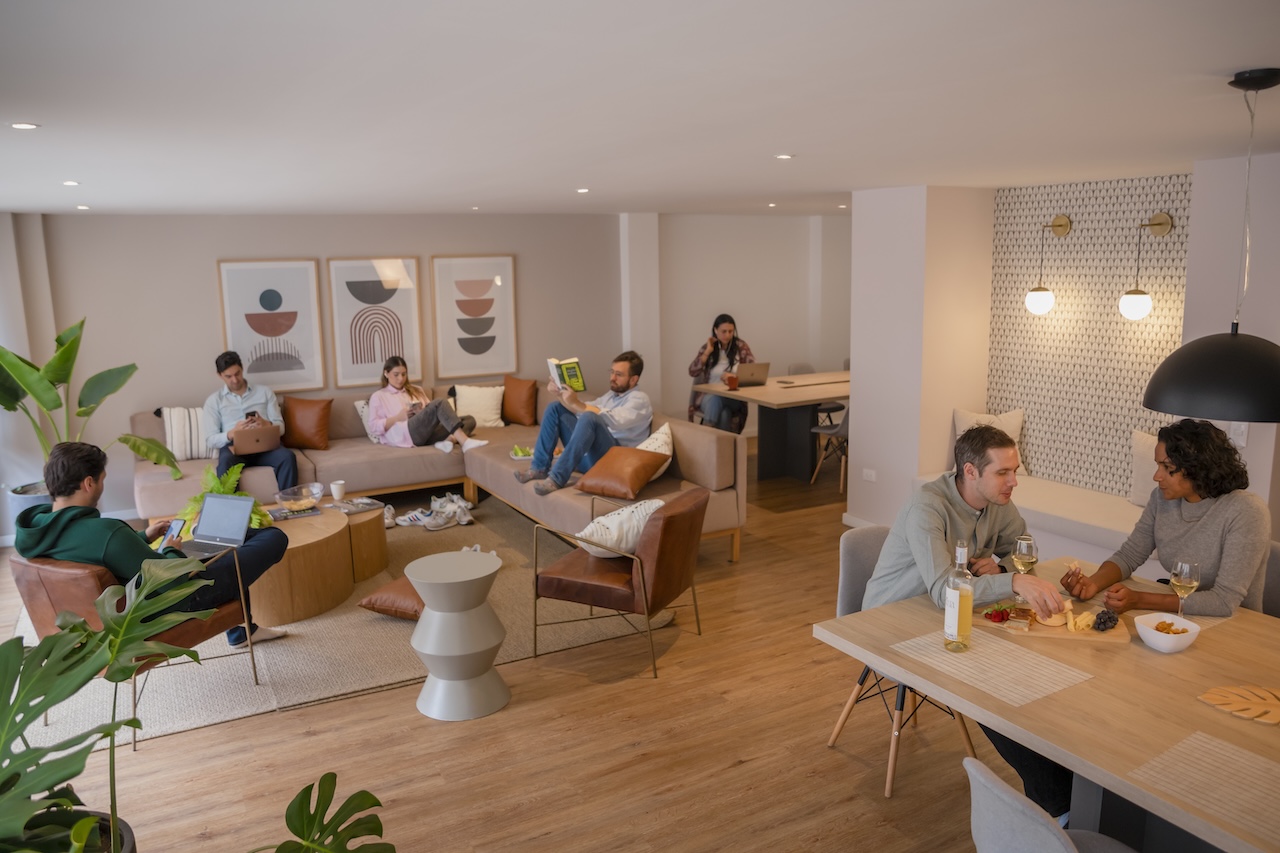
CoDNX curates a network of coliving spaces across its coverage countries. These are not anonymous rentals. They are intentional residential communities — places with a household feel, shared common areas, and residents who are there because they chose to be part of something. When you arrive through CoDNX, you are placed into a community that is expecting you. The friction of the first week in a new city — the isolation, the aimless café-hopping, the not-knowing-anyone — is largely eliminated.
What CoDNX adds on top of the coliving layer is rigour about integration. Colivings in the network are selected partly on the basis of their relationship with their surrounding city and neighbourhood. A coliving that sits behind its own walls with no relationship to its local context is not what the platform is building toward.
The Canvas — Where You Work and Create
This is the part of CoDNX that has no real equivalent in the market. The Canvas is a curated network of local spaces — yoga studios, tattoo parlours, music venues, culinary academies, art galleries, climbing gyms, maker workshops — where CoDNX members can use, teach, perform, and earn. Not as tourists attending a drop-in class, but as practitioners plugging into the local professional ecosystem.
A movement coach arriving in Bogotá can find gym space and a morning teaching slot. A graphic designer landing in Lisbon can connect with a studio residency. A Japanese chef in São Paulo can run a tasting workshop. The Canvas makes these connections available from arrival, not after weeks of searching. The venue wins too — it gains access to a global audience of skilled practitioners who bring new techniques, new clients, and new revenue into the neighbourhood.
The spaces CoDNX connects through the Canvas include: colivings, masterclasses, ateliers and galleries, wellness sanctuaries, innovation hubs, culinary institutes, expeditions, acoustic venues, maker studios, visual arts studios, ecological immersions, and movement dojos.
The Network — Institutional Roots on Arrival
The third layer is what makes CoDNX genuinely different from every other platform in this space. CoDNX's partnerships with Impact Hub, civic agencies, startup accelerators, and NGOs mean that arriving through the platform gives you real access to a city's institutional life — not a map, but an introduction.
In Colombia, this means access to Impact Hub's ecosystem and the Enterprise Europe Network from day one. In other markets, it means connections to governments actively building digital nomad visa infrastructure, to accelerators running global cohorts, to NGOs that need specific professional expertise. The principle across all of these is the same: eliminate the weeks it normally takes to find your place in a new city.
What Arriving Through CoDNX Actually Looks Like
The clearest way to understand the platform is through a concrete scenario — one the CoDNX team uses itself to illustrate the difference between the old model of global movement and the new one.
Picture a Japanese tattoo artist relocating to São Paulo for three months. Under the conventional model: she arrives as a tourist, books a short-term rental, spends the first two weeks in the aimless limbo of not-quite-living-anywhere. She finds a café she likes. She meets a few other foreigners in a similar limbo. She spends money. She leaves as a ghost — barely present in the city's productive life, contributing nothing that stays.
Under CoDNX: she moves into a coliving with eight other creators — a Parisian wine expert, a Brazilian tech founder, a dancer from Buenos Aires. They share meals and ideas from the first evening. Through the Canvas network, she connects with a São Paulo tattoo studio and lands a month-long residency, teaching traditional tebori technique to local artists who have never encountered it. The studio gains international credibility. She covers her costs by week three. When she leaves, the studio has a global reputation, her housemates have a new perspective on craft, and the city is measurably richer — in revenue, in skills transferred, in culture deepened.
This is not a pitch deck hypothetical. It is a description of what becomes structurally possible when a professional with real skills has the infrastructure to deploy them immediately on arrival, rather than spending the first month finding her footing.
The Impact Hub Partnership and the Institutional Architecture
CoDNX's most significant institutional partnership is with Impact Hub — one of the world's largest entrepreneurship networks, present in more than 120 countries with a membership exceeding 500,000. The partnership is not a logo arrangement or a sponsorship. It is a structural alignment built on a shared premise: that skilled professionals deserve the infrastructure to build and contribute wherever they are, not just where they were born.
In practical terms, a CoDNX member landing in Bogotá or Cali skips the weeks of aimless networking. They are immediately inside Impact Hub's ecosystem — the accelerator programmes, corporate matchmaking sessions, innovation workshops, and through Impact Hub's Enterprise Europe Network in Colombia, direct connections to European business institutions. When Impact Hub delegations travel internationally, they stay in CoDNX colivings. The exchange moves in both directions.
The Impact Hub partnership frames CoDNX's broader approach to institutional relationships. The platform actively builds partnerships with: innovation agencies and entrepreneurial syndicates (like Ruta N and Endeavor), academic institutions and startup accelerators, civic governments running digital nomad visa programmes, wellness centres and somatic practice communities, creative residencies and independent galleries, acoustic venues and performance stages, NGOs and impact funds, and culinary academies and gastronomic societies.
The stated criterion for all of these: a genuine strategic alignment built around borderless human flourishing. Not a logo deal. Not hollow cross-promotion. The question CoDNX asks of every potential institutional partner is whether the organisation actually shapes cities and cultures — and if not, the conversation ends there.
The Category That Did Not Exist
To understand why CoDNX matters, it helps to map what existed before it and why each piece was insufficient on its own.
Coworking spaces gave nomads a desk but not a community, a city, or a way to earn locally. Accelerators built world-class programmes but fixed them to a single geography. Coliving buildings created beautiful spaces but left them isolated from the surrounding city economy. Digital nomad visas granted legal permission to arrive but provided no structure for belonging once you did. Startup ecosystems thrived locally but rarely connected across borders in a way a newly arrived nomad could step into.
Nobody had built the thread connecting all of these into a single, trusted network — one a person could enter anywhere in the world and immediately feel oriented, economically active, and socially embedded. That gap is CoDNX's domain.
The platform does not describe itself as a hospitality company or a real estate company. It describes itself as operating infrastructure — the system that makes the entire nomadic professional ecosystem function as a coherent whole rather than a collection of parallel, isolated worlds. The global mobility layer is not a product category that existed before CoDNX. It is the category CoDNX is creating.
What People Are Saying
"CoDNX connects digital nomads and local professionals to colivings, creative venues, and peer-led experiences, so you can build a life around what actually brings you joy. We're launching in Colombia, Portugal and Spain." — Marvin Tchio, Threads, March 2026
"Building CoDNX. A platform connecting nomads to coliving spaces, shared creative spaces and peer-led experiences. Now, if you can surround yourself with the right people, and can host in-person workshops or experiences, you can become a digital nomad." — Marvin Tchio, Threads, January 2026
"CoDNX creates complete development ecosystems where travel becomes a catalyst for mutual growth. We connect three essential elements: traveling professionals seeking meaningful experiences, local experts and businesses wanting to expand their reach, and co-living communities designed for growth and collaboration." — CoDNX, LinkedIn, 2026
Consistent themes across all early public communication: the word mutual recurs in almost every description. In a market saturated with platforms that extract value from destinations — paying for access, leaving with content, moving on — CoDNX is explicitly and structurally building for reciprocal exchange. That is not a marketing position. It is a product constraint that shapes every partnership decision, every venue selection, and every community the platform builds.
Pros & Cons
Pros
The category insight is genuine and large. The global mobility layer is a real gap in the market, and no one else is building it with this level of institutional ambition. The problem CoDNX is solving is not a niche problem — it is the fundamental problem of professional global movement in the 2020s.
The Impact Hub partnership is a structural signal, not a logo deal. Immediate access to 120+ countries of entrepreneurship infrastructure from day one of arrival is a meaningful competitive advantage that no coliving platform or booking site can replicate.
The two-track model solves two problems simultaneously. Most platforms solve either where to sleep or how to network. The Sanctuary and Canvas together solve both — and the institutional layer adds a third dimension that the rest of the market has not thought to address.
The founding story is honest and specific. CoDNX was conceived as an answer to a problem Tchio lived firsthand, validated through 55+ interviews, and tested in Oaxaca before it was scaled. That sequencing produces better product instincts than a business that started with a deck.
The reciprocal-value philosophy is a structural differentiator. Platforms that give real value back to host cities — not just extracting from them — build more durable local partnerships and longer-lasting community loyalty. CoDNX has made this its explicit design goal.
The network effect is already building. 23 countries, 500+ spaces, 120+ institutional partners is a meaningful head start on the network density that makes this kind of platform exponentially more valuable over time.
Cons
CoDNX is a young platform. The coliving network launched formally in 2025. The track record at scale is still being built. Early adopters are participating in something real but still forming — not stepping into a mature, fully systematised operation.
The Canvas layer will vary by city. Local venue partnerships are built city by city and take time. Coverage will be deeper in the launch markets — Colombia, Portugal, Spain — and thinner in newer additions to the network.
The model requires participation, not just occupancy. The value is generated by engagement. If you want to arrive, pay, and be left alone, CoDNX is not the right platform.
The experience is not yet uniform across the network. Some cities will be deeply developed; others will still be finding their operational rhythm. Research the specific city you are heading to, not just the platform in general.
CoDNX is not primarily a budget option. The value proposition is integration, access, and community — not the cheapest room in a given city. The right question is not "how does the price compare to a hostel?" but "how does the value compare to arriving alone?"
How CoDNX Compares
Factor | CoDNX | Standard Coliving Platform | Booking Platform |
Core proposition | ✓ Global mobility layer | Curated accommodation | Accommodation transaction |
Local ecosystem access | ✓ Institutional partnerships built in | Rare, ad hoc | None |
Earn locally on arrival | ✓ Canvas network enables this | Not a feature | Not a feature |
Community on arrival | ✓ Built into the model | Varies by space | None |
Value flows to host city | ✓ Explicit design goal | Incidental | Mixed |
Institutional partners | ✓ 120+ (Impact Hub, civic agencies) | Few or none | None |
Countries covered | 23 | Varies (typically 5–15) | 200+ |
Participation required | Yes — engagement is the product | Optional | None |
Track record | Young (2025) | Varies | Well established |
CoDNX is not competing with Booking.com or Airbnb on their own terms. It is not even competing with standard coliving platforms on their terms. It occupies an entirely different category — one where the question is not "where do I sleep?" but "how do I actually become part of this city, and contribute something real to it while I'm here?" That distinction is the whole ballgame.
Who CoDNX Is For — and Who Should Look Elsewhere
A strong fit if you:
Want genuine local integration, not just an aesthetically pleasing room in an interesting country
Are a founder or entrepreneur who needs ecosystem access from day one, not week four
Are a creative — musician, artist, coach, chef, instructor — who can teach, perform, or produce locally and wants a structure that makes that possible from arrival
Have spent time in colivings and found them beautiful but disconnected from the actual city around them
Are an organisation — accelerator, government, NGO — looking for trusted infrastructure to handle the living and integration layer for your globally mobile cohort
Are in a transitional chapter of life and want a community that matches your level of intentionality
Probably not the right fit if you:
Want a passive, hotel-style experience where everything is handled and you remain a guest
Are optimising purely for price with no interest in community or local engagement
Need a platform with years of reviews and fully systematised operations at every location
Are a short-stay tourist with no intention of participating in the city's productive life
Want large-scale, guaranteed uniformity across every city in the network from day one
The clearest test: if the idea of landing in Medellín with a coliving community already expecting you, a morning studio slot already arranged, and an introduction to the local Impact Hub chapter waiting in your inbox genuinely appeals — CoDNX is built for exactly that.
Final Verdict: Is CoDNX Worth It?
For the right kind of person — yes, unambiguously.
CoDNX does not fit the standard nomad platform template. It is not a productivity hub with nice common areas. It is not a global hostel chain with a community Slack. It is infrastructure — built on the premise that the most valuable thing you can give a mobile professional is not a clean bed and fast internet, but immediate orientation, instant community, and a way to participate in a city's economic life before the end of the first week.
The Canvas network, the Impact Hub partnership, the institutional architecture behind every city in the coverage map — these are not features. They are an argument that the old model of global movement, in which brilliant people arrive in city after city as consumers and leave as ghosts, is both unnecessary and wasteful. CoDNX is making the case that you can arrive, and immediately belong. That your skills can travel as freely as you do. That the city you are visiting can be genuinely richer for having you in it — not as a source of Airbnb revenue, but as a practitioner, a collaborator, a participant.
The honest qualifications are real: the platform is young, the Canvas layer's depth varies by city, and the model requires genuine engagement rather than passive occupancy. These are not failures — they are the honest conditions of a platform still in the process of building the thing it set out to build.
For a founder who needs to hit the ground running in Bogotá. For a creative who wants to teach and earn in Lisbon rather than just exist there while burning through savings. For a professional who has spent too many months arriving in extraordinary cities and feeling structurally excluded from their productive life — CoDNX is making a direct and serious argument that the alternative is possible.
The studio slot is waiting. The Impact Hub introduction is ready. The coliving community is expecting you. And somewhere in the city you are about to land in, a neighbourhood business is about to gain a global collaborator it didn't know it was missing.
That is a genuinely good deal.
FAQ
What does CoDNX stand for? CoDNX stands for the CoLiving Digital Nomad Experience. The name reflects the platform's origins as a coliving-focused network, though it has since expanded into a broader global mobility layer encompassing colivings, creative venues, institutional partnerships, and peer-led experiences.
Is CoDNX a coliving platform? It includes a curated coliving network — the Sanctuary — but it is more accurately described as a global mobility layer. The Canvas is the venue and experience network where you work and create. The institutional partnerships are the ecosystem layer that gives you access to local professional and entrepreneurial life on arrival. Together they form a system, not a listing site.
Which countries does CoDNX cover? The network covers 23 countries, with the launch focus on Colombia, Portugal, and Spain — three of the highest-density nomad destinations globally and the three where the founding team's institutional relationships are deepest.
Who founded CoDNX? Marvin Tchio, a former IBM engineer and longtime digital nomad. Tchio studied Computer Engineering at Virginia State University, left a conventional career to live and work across borders, spent a year interviewing 55+ people who had built lives on their own terms, tested the first proof-of-concept at Co404 in Oaxaca, and built CoDNX from that experience outward.
What is the Canvas? The Canvas is CoDNX's venue network — a curated map of local spaces (yoga studios, galleries, gyms, culinary institutes, acoustic venues, maker workshops) where CoDNX members can work, teach, perform, and earn from arrival. It is the part of the platform that makes economic productivity possible from day one in a new city, not after weeks of searching.
What is the Impact Hub partnership? Impact Hub is one of the world's largest entrepreneurship networks — 120+ countries, 500,000+ members. CoDNX's partnership gives its members immediate access to Impact Hub's ecosystem in each city: accelerator programmes, corporate matchmaking, and in Colombia, connections to the Enterprise Europe Network. The exchange is mutual: Impact Hub members travelling internationally stay in CoDNX colivings.
How is CoDNX different from Airbnb or a coliving booking site? Airbnb and standard booking platforms optimise for the transaction — the booking, the stay, the checkout. CoDNX optimises for integration: for the professional who wants to belong to a city, earn in it, and contribute to it, not merely occupy it. The Canvas, the institutional partnerships, and the community model are all built toward that goal, which no booking platform has attempted.
How do I join CoDNX? Visit codnx.com to explore colivings and experiences, or reach out to the team directly at @codnxinc on Instagram and Threads. The team actively engages with potential members and recommends a conversation before committing to the network.
Is CoDNX right for non-entrepreneurs? Yes. The platform is built for anyone who creates, teaches, performs, designs, builds, or practices a skill — and who wants to do that in cities beyond their own. Coaches, musicians, chefs, yoga instructors, visual artists, and researchers are all part of the intended community. The entrepreneurial framing reflects the founding context, not a restriction on who can benefit.
Last updated: June 2026 | Based on codnx.com site content, Marvin Tchio's public posts on Threads and LinkedIn, CoDNX's stated partnership documentation, and independent research on the global coliving and digital nomad ecosystem.